Audio Transcript
00;00;00;58 - 00;00;23;38
Geoff Mearns
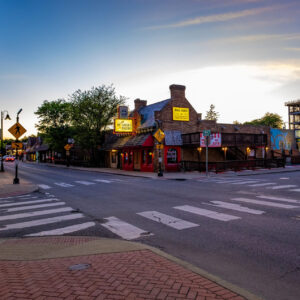
Steps away from Ball State University, The village is a commercial district that is home to apartments,
shops, restaurants and more. With a major revitalization
underway, the village is about to look much more different.
And students from our Estopinal college of architecture and planning,
they're playing a role in the change. I'm Ball State President Geoff Mearns
and this is Cardinal Compass, Campus and Community Conversations.
00;00;23;42 - 00;00;39;22
Announcer
From the campus of Ball State University on Ball State PBS
and Indiana Public Radio. This is Cardinal Compass.
Campus and Community Conversations.
00;01;01;08 - 00;01;09;46
Announcer
At Ball State University, we inspire cardinals
to transform their communities, to revolutionize
their industries, and to make a difference.
We fly. Are you ready to fly?
00;01;19;56 - 00;01;23;18
Calvin Scott
Hello and welcome to Cardinal Compass. I'm Calvin Scott.
00;01;23;18 - 00;01;25;00
Brooke Follrad
And I'm Brooke Follrad.
00;01;25;00 - 00;01;33;40
Calvin Scott
The Ball State Village
Revitalization Project has been making headway
since 2024, ranging from the new Performing Arts
Center to the Center for Innovation and collaboration.
00;01;33;40 - 00;01;39;22
Brooke Follrad
Yiting Zhang dives into what comes next year
for the four year plan to strengthen the local community.
00;01;39;22 - 00;01;58;16
Yiting Zhang
The village redevelopment plan dates back to decades ago, when Ball State students called
for a more vibrant village. Now, university
leaders said the Village Green Project is a key
step that vision design as a flexible space
for events, local businesses and year round community gathering.
00;01;58;16 - 00;02;18;06
Chris Palladino
An outdoor gathering place and a recreation space
that we really see as being the heart of the village
that's going to draw in the Ball State community and a greater mind
see community together.
So that would be a space that would have different programming opportunities.
There might be lawn games, small concert events, we think it's going
to be very valuable for students.
00;02;18;06 - 00;02;28;20
Yiting Zhang
However, as the village continues to evolve, not everyone sees the changes
the same way. Some longtime community members said it has
already changed significantly.
00;02;28;50 - 00;02;49;18
Deb Wise
So over the years, when I used to come here
as a teenager, it's much different than it was then.
Some of the buildings are still here. I'm not sure I'm in love with
because they shadow the village. But we have to go with progress,
I guess.
And it's changed from being more retail bound to, I think being more
of a dining experience.
00;02;49;24 - 00;02;59;10
Yiting Zhang
Wise also reflects on the Village Green Project, saying she sees it
as part of the area's continue evolution and the latest step
in its ongoing transformation.
00;02;59;22 - 00;03;13;32
Deb Wise
It will be an open space with landscaping, outdoor tables.
We're talking they're talking about possibly
even being able to show movies on the side of the Game
Stop building.
00;03;13;50 - 00;03;16;34
Yiting Zhang
When the green project is completed, let's imagine what
interesting thing will happen.
00;03;16;34 - 00;03;35;56
Deb Wise
So if it's a beautiful summer day
and you want to get your drink and go over there and hang out,
it's going to be the perfect spot for it.
So I think, again, it is going to bring town and gown together. It won't just separate the village with the city, it will combine them.
00;03;35;56 - 00;03;49;30
Yiting Zhang
The village's continual renewal and expansion
are not just for any one group. It serves as a bridge
connecting both state with the surrounding communities
and the entire Muncie area. In Muncie, Yiting Zhang,
Cardinal Compass.
00;03;53;22 - 00;04;00;12
Calvin Scott
Joining us now is Eric Mainzer and Teresa Jeter,
assistant teaching professor of landscape
architecture and urban planning.
00;04;00;12 - 00;04;06;40
Thank you for joining us
From your perspective, What was the purpose of creating
a competition like this for students?
00;04;18;36 - 00;04;29;12
Eric Mainzer
Oh, this was a great example of trying to get the students
into a situation they feel invested in.
And because they're the ones who are living and using
the spaces down in the village, they were aptly suited to be
the ones that were designing for the needs for the space.
00;04;29;26 - 00;04;34;58
Brooke Follrad
Yeah, that's a good perspective to have the students themselves
do it, considering it's so close to campus for sure.
Thank you. Yeah.
00;04;55;40 - 00;05;03;18
Teresa Jeter
This gave the students certainly an opportunity to be a part of the
real world opportunity not to only serve the campus but also
the residents, faculty, staff, other students in helping to design
this particular site in the village.
And so this was a great opportunity
for students to learn and engage the community.
00;05;03;18 - 00;05;35;02
Geoff Mearns
And as you know, all across campus,
particularly in this program, that we provide students
with real world, practical, experiential learning
opportunities.
And as you said earlier, Brooke, the ability
to get the students perspective, we want to draw more students
to to the village and what better way to do it
than to ensure that the students have a voice and a perspective.
But what I was pleased with, and I suspect
you'll ask our guests, is that they engaged
the broader community, not just the merchants
and the neighbors immediately
adjacent to the village, but they went downtown to get
ideas from across the community.
00;05;35;26 - 00;05;41;22
Brooke Follrad
Absolutely.
I know that hands on experience is what drew me to Ball State.
So it is amazing, wonderful opportunity.
00;05;41;34 - 00;05;47;32
Calvin Scott
What skills do you see students gain from experiences like this
that they may not get in a traditional classroom setting?
00;05;49;08 - 00;06;30;48
Teresa Jeter
Oh, community engagement
is extremely important. They were able to interview
a number of people. They also had the opportunity
to sharpen their interview skills, interact
with stakeholders, alumni as well.
And so it's very important to get outside the classroom
and our studios provide that those opportunities
for students.
I mean, it's very important for them to certainly
be a part of the real world, not just the books,
not just listening to faculty, but also experiencing
the feelings and seeing the expressions of those who
certainly had input into into this process
00;06;31;02 - 00;07;05;46
Eric Mainzer
And building off of that.
What you said about getting that experience
in landscape architecture, we often tell the students,
you know, if you really want to understand
the site conditions, you need to spend time
at that location because people aren't just visiting that site.
At one point during the day, they could be going
there at any time, any season.
You know, what's it look like at night?
What's it look like in the morning?
So having a site that was close to campus
that the students could go and visit
multiple times throughout the day.
See what it's like when it's rainy,
when it's sunny to truly understand
the area that they were designing for.
00;07;05;46 - 00;07;15;30
Brooke Follrad
I think that's such a thorough part of design
is making sure you're thinking about all aspects
and all different kinds of people.
Sounds like a very big project
for that.
What were some of the steps that get this
project into development?
00;07;17;54 - 00;07;56;14
Eric Mainzer
Some of
the first steps that we took as the studio was thankfully the
some of the faculty in urban planning had prepared
a lot of the base information.
They had set up online sites to gather
information from the community through interviews
to find out what the needs and desires were for the space.
And then in terms of our studio, we started off the same
we would with any project is introduce the problem,
then encourage students to empathize with the problem
better understand what the problem, the design problem is.
Go down to the site, analyze the site,
and then come back to studio and start brainstorming how.
00;07;56;14 - 00;08;40;10
Teresa Jeter
There was a two hour tour of the village.
And so students had an opportunity
to get out there among the people and interview, etc..
The challenge, I would say the challenge, I would say
making sure that it was all encompassing
in terms of the process is how we made the experience
interdisciplinary for all of the four departments
in the college, which we're happy to say
all were involved interdisciplinary teams as well.
And so that could have been a challenge because everybody didn't
like it to work in teams.
But this was very a very good opportunity and not a challenge,
but an opportunity to learn.
00;08;40;32 - 00;08;45;04
Calvin Scott
You know, you mentioned challenges. What were some of
the biggest challenges into bringing this idea to life
00;08;48;50 - 00;09;20;58
Eric Mainzer
For the contest? The biggest challenge
we always have with any project is time schedule.
You know, the students start designing,
they become really vested in the process
and they just want to keep designing, keep tweaking, keep refining
and keep making it better. And the biggest challenge
is getting them to go, okay, this is good.
We need to stop. We need to move on
to the next part. We need to start in construction
drawings, the finalized renderings.
So that's often the biggest challenge,
getting them to have to like put on the brakes
and shift to the next phase.
00;09;21;04 - 00;09;31;1
Geoff Mearns
Well, and I would imagine that's also a practical experience
because after they graduate, they're going to have a client
who will have a schedule and they need to meet
that schedule.
00;09;31;18 - 00;09;37;04
Eric Mainzer
Yes, Yep, very much. It's getting them prepared
for the real world and schedules, budgets,
those kind of constraints.
00;09;37;04 - 00;09;46;44
Brooke Follrad
Yeah, which is important. And speaking of that real world
experience, Teresa, how is your expertise in urban
and regional planning, like your master's degree
allowed you to contribute to this project?
00;09;46;44 - 00;10;54;36
Teresa Jeter
One of the things I love about urban planning that I learned in
and through the program is engaging people
to get the real input. That's very important,
very critical, because, I mean, we can design all day
and have all these lofty ideas, but what does that mean?
That people aren't enjoying them or potentially not enjoying
the outcome or the impact that was developed or designed?
And so I've learned to work with people
to get out of my comfort zone, so to speak,
because it's very important again, that and what
I learned through the master's program in regional planning
was to certainly be confident in what people are telling me,
be confident in the design elements, be confident
in examining situations and communities, and certainly
for people to feel welcomed and for people
to feel that the designs and the engagement is truly one
that we are passionate about. So that's very critical.
00;10;54;36 - 00;11;15;50
Geoff Mearns
How do you emphasize the point of listening?
Right, Because the students and us
professionals have some preconceived notions, ideas
for what to do on that site. But three says you emphasize
when it comes to urban planning, it's so important
to listen to the people. How do you emphasize that point
in a project like this?
00;11;16;24 - 00;11;43;12
Eric Mainzer
One of the things we start with the students from first year
is it's great to have all these design ideas,
but you have to remember you're never or very rarely
will you have the opportunity to design for yourself.
You're always designing for somebody else.
So all of our projects kind of encourage
the students to be able to look through
a different lens, to be able to see the site,
the problem, the area through the eyes of someone else
and what their needs and desires are.
00;11;43;12 - 00;12;17;4
Teresa Jeter
And that's why we created a poll to get to kickstart, you know,
for for this opportunity. We didn't tell the students,
go down, check out the site yet. We had a poll and the results
were already coming in. I think our initial responses
were 800, which is unheard of and then ultimately close to 2000.
And so that's the information students had
as when they went to the site and looking at the site
and certainly listening to and the the conversations of
individuals and what they said in those polls.
00;12;17;44 - 00;12;25;14
Calvin Scott
Yes, sounds great in a quick way
of saying how does landscape architecture and urban
planning go hand in hand?
00;12;26;30 - 00;12;49;28
Eric Mainzer
There is a fair amount of overlap between
the two disciplines to the point where as first year
they start off in the same group before they kind of
splinter off. And it really is about
understanding the design problems, understanding the communities,
the people that are going to be inhabiting those spaces and
just the scale of the projects.
00;12;49;40 - 00;13;07;52
Teresa Jeter
They're very complementary at the core, both.
And so while urban planning, they deal with community
engagement, policy, zoning, land use, all the things
the urban design piece is very important as well.
And so I say they very complementary.
00;13;08;52 - 00;13;14;04
Brooke Follrad
Thank you. 54 Village Green Designs were submitted
for the college architecture and planning competition.
00;13;14;04 - 00;13;19;56
Calvin Scott
Dylan Rosenblum highlights the hard work
that went into the competition and how these designs inspired
the Village Green Project.
00;13;21;30 - 00;13;36:40
Dillon Rosenlieb
Buildings are all around us, often seen as everyday spaces
we use for convenience. But we don't always
see the stories and perspectives built into their foundations
for Ball State architecture students,
every project has a story.
00;13;36;40 - 00;13;48;36
Dave Ferguson
emphasized the fact that design process is also universal.
So we have all of our students have a fundamental approach
that they can use to get them to the end product.
00;13;48;36 - 00;14;05;52
Dillon Rosenlieb
Communities are built by the shops, cafes and people who give them life.
But beyond that, growth are those who help plant the seeds
of what a community can become. For Ball State architecture
students, that means designing with the will need in mind.
00;14;05;52 - 00;14;25;32
Dave Ferguson
They do get engaged in the issues that those clients, those future
clients really want to be talking about.
And so we consider hands on, sometimes called community
based projects or immersive learning projects
within our college setting as one of the most important
things that we can put into the portfolio of our students.
00;14;26;42 - 00;14;46;50
Dillon Rosenlieb
It's one thing to design it. It's another to see your idea
take shape and become part of something that brings people
together for years to come. That's what the College of
Architecture brings to the table competitions that gives students
the chance to work together and see their ideas,
breathe life into communities.
00;14;49;12 - 00;15;02;50
Brooklyn Farrell
I just hope that we can become more well informed.
We don't stay in our bubble. We learn about all types
of cultures, heritage, disability, so we can be
well informed designers and then promote spaces.
They're inclusive of all people.
00;15;02;50 - 00;15;17;48
Dillon Rosenlieb
The future isn't just built on innovation, but on the idea
that if you can dream it, you can build it.
And with every design comes a story.
When people are different voices and ones that will echo
for generations to come. Dillon
Rosenlieb, Cardinal Compass.
00;15;21;02 - 00;15;28;46
Calvin Scott
Joining us now are Justin Butts, a member of the winning design
competition team, and Ashley McGuinn,
a member of the third place team. Thank you for joining us.
00;15;28;46 - 00;15;33;58
Brooke
When you first heard about the Village renovation project,
what made you want to enter?
00;15;33;58 - 00;15;56;00
Justin Butts
I think for me it was landscape architecture.
We in the college, we don't have many competitions,
so being able to showcase landscape architecture
and showing what we can do, I think was very important
and also getting the opportunity to be able
to make a change on campus and just make something
that people remember.
00;15;56;00 - 00;16;06;32
Ashley McGuinn
Yeah,
I like to take every opportunity I can, especially something like this.
That's a really great way to get involved in a real world
project.
00;16;06;32 - 00;16;19;14
Calvin Scott
Yeah, Thank you. And when you say taking every opportunity
that you can and, you know, the cap building,
having that many competitions, can you walk us through
your creative process from your first idea
to your final submission?
00;16;19;14 - 00;16;52;40
Justin Butts
Yeah. So with our with the survey that was put out,
we gathered all of the information, looked over all of it,
kind of analyzed it, and then after that kind of
just went into different design iterations,
looking at different things, considering cost
and what the students want and then what the community
wants and putting those all into concepts ultimately
making a conglomeration of the different concepts
and coming up with our final design,
00;16;52;40 - 00;17;13;42
Ashley McGuinn
Similar to Justin and all started with the survey
we really wanted to prioritize what the students
and what the community wanted, and we brainstormed. From there.
We came up with a few different ideas of settling on a
like central gathering space and developed through
the production from there, going back and forth,
bouncing ideas.
00;17;13;42 - 00;17;20;52
Brooke Follrad
Yeah, and with such a real life project, how did you think
that your coursework in the CAP program
really prepared you for this?
00;17;20;52 - 00;17;45;22
Justin Butts
I think throughout CAP we do a lot of different sizes
of projects, especially in our later years, getting down to smaller projects
and being able to again with the real life projects,
getting to show like considering cost and everything.
That's something that's really pushed towards the end and considering,
um, especially with like the community engagement,
what they want.
00;17;45;48 - 00;17;59;28
Ashley McGuinn
Yeah, and CAP provides a lot of practical skills towards
developing something like this, like how to do a site analysis,
but ultimately they teach you how to think
and how to be a designer and apply certain things.
00;17;59;28 - 00;18;06;38
Calvin Scott
Yeah, wonderful. What ideas did you have for the village
renovation competition to be considered?
00;18;07;16 - 00;18;33;06
Justin Butts
Um, I think like we talked about before, the biggest
idea and consideration was the community
and seeing what they wanted. And then again, like the cost.
And it was something that they wanted us to consider.
And if we wanted our design to stand out is to make it sustainable
and being able to be a lower cost that can actually be
implemented.
00;18;33;06 - 00;18;41;02
Brooke Follrad
Yeah, and one thing I am interested here, you guys were talking
about the different ideas you had.
Do any of you have any other ideas that you would
love to see in this project?
00;18;41;02 - 00;18;51;58
Geoff Mearns
Something that didn't make it into the design competition
that now, upon reflection, maybe you thought
because we're in the process of translating
all of your ideas into the actual design.
00;18;51;58 - 00;19;16;06
Justin Butts
Um, I think the design team that ultimately of came up with the new design,
I think implemented it very well of what our projects had.
I did really enjoy one part of Ash's
project with the village being able,
the big sign, being able to actually stand in it
and making a big like photograph moment.
00;19;16;06 - 00;19;16;54
Brooke Follrad
Yeah, yeah.
00;19;16;54 - 00;19;45;46
Geoff Mearns
And as you may is referring to Ash, thank you for bringing it
to our attention. You know, there isn't a whole
lot of branding in the village. I think there's like a mural
on the side of roots. We all know it as the village,
but if you're not from the area, you don't know
what we're talking about. So that idea of having,
you know, an iconic symbol that people can take photos on
and blasted out all across social media was,
you know, a light bulb moment. It was also one of those moments
where we thought, like, why didn't we think of that earlier?
So it was a great, great addition to the project.
00;19;45;46 - 00;19;57;02
Brooke Follrad
Yeah, of course. And I think that's kind of what
we were speaking on earlier about things
we didn't think of and immersing yourself into it
and realizing things that you may be missing.
Absolutely. Thank you. What moments stuck out to
you guys during this process?
00;19;57;02 - 00;20;18;24
Ashley McGuinn
For me, I think it was my first time on the site looking at it
through a design lens. It's not often that you go to a site
knowing like it's going to look different in a few years,
and a lot of that will come from students perspectives.
So it was just a completely different experience
from what I'm used to, and that was a really lovely moment.
00;20;18;24 - 00;20;34;34
Justin Butts
I think mine would be probably more towards the end of the competition,
getting to be able to present our our design in front of
probably the largest group of people that we've had to throughout CAP.
I think that was probably my most memorable moment.
00;20;34;34 - 00;20;44;08
Calvin Scott
Yeah. Now, Justin, earlier you mentioned, you know,
we wanted to look into the community.
What difference do you guys both feel
you were making with this project?
00;20;44;08 - 00;21;14;20
Justin Butts
I think that this project is able to create a sort of hub for the village,
bringing in people from both the community and ball
state and being able to create a space where anyone's welcome
and where people can just relax, enjoy some of the surrounding
amenities and businesses and be able to just talk to each other
and ultimately connect to both the community and Ball State.
00;21;14;20 - 00;21;28;24
Ashley McGuinn
Yeah, I think Justin's completely right. Hopefully
the difference with this makes is it will unite students
and community members and local vendors
and just really facilitate that.
00;21;28;24 - 00;22;12;48
Geoff Mearns
To me, obviously ultimately the physical manifestation
will be an enduring difference. To me, the process
is that they engaged in, you know, oftentimes
a community around a university feels that when the university
comes out to do a joint project, that the university
is going to do it for the community
or to the community. Their engagement process ensured
that this was a collaborative effort, that we were doing
something together with the community,
something that will benefit the university community
and the broader community. I think the enduring impact
will also be continue to reinforce to our friends and neighbors
all across the community that we want to be
genuine partners with them and listen to them
and incorporate their ideas and concerns into the work
that we do with them in the community.
00;22;12;48 - 00;22;13;56
Brooke Follrad
Yeah, and that kind of sounds like it's going to be bridging
that gap of the town gown.
00;22;16;56 - 00;22;18;44
Geoff Mearns
One more step in building that bridge.
00;22;18;44 - 00;22;28;12
Brooke Follrad
One more step, of course. Now, Justin, did your experience
in the American Society of Landscaping Architects
Indiana chapter help you to participate
in this whole process?
00;22;28;12 - 00;22;52;48
Justin Butts
I think being a member is like it helps to give us a good idea and
example of different projects in real world of similar scale
to what we were going to be working on.
And throughout like our conferences, being able to sit in on different lectures
and learn different information about sustainability
and different things like that, I think really helped. Yeah.
00;22;52;48 - 00;22;58;14
Calvin Scott
And then for you Ash, what challenges did you face during the project
and how did you push through them?
00;22;58;14 - 00;23;21;30
Ashley McGuinn
My biggest challenge was that my partner wasn't in architecture and my partner
was in urban planning and she was staying at the studio,
whereas I was doing it more in my own time.
So balancing that schedule was a really big challenge,
but we were able to work through it pretty well
and it was an amazing collaborative process.
It was really nice to work in an interdisciplinary setting.
00;23;21;30 - 00;23;22;08
Calvin Scott
Oh, great.
00;23;22;08 - 00;23;29;20
Brooke Follrad
That's amazing.
And a quick response that you can think of.
How do you think that this experience has shaped you both?
00;23;29;20 - 00;23;50;54
Justin Butts
I think it's given us good skills, especially for a real
life project. Being able to again work with the community
I think is the biggest part and giving us information
like how to do that and how vital it is to a project.
00;23;50;54 - 00;24;06;52
Ashley McGuinn
And it really brought a lot of the community
aspect and really like taught us the value in that
and the advocacy elements and having a voice in
shaping a local community. So hopefully that's something
we continue to bring in our careers.
00;24;06;52 - 00;24;09;52
Brooke Follrad
Yeah, thank you so
00;24;10;06 - 00;24;12;44
Calvin Scott
Thank you.
That's all the time we have
for that part of the discussion.
00;24;12;44 - 00;24;17;22
Brooke Follrad
President Mearns, We want to give you
the final minute for your reflection
on today's conversation.
00;24;17;22 - 00;24;55;44
Geoff Mearns
Well, Ash and Justin, thank you for joining us for the program.
But more importantly, thank you for your contributions
to this important element in the Village Revitalization
Project.
And Calvin and Brooke, thank you for giving us
the opportunity to showcase this project.
You know, the Village project
will be the manifestation
of what this program is all about the connections,
the positive collaborative connections
between the university and the community.
And so as a result of this good work,
the Villages will be an increasingly
welcoming place for people all across the community,
and it will prove once again that between Ball State
University and Muncie and Delaware County
that we are truly better together. So thank you.
00;24;55;44 - 00;24;59;54
Brooke Follrad
Oh, that's nice. Thank you.
Thank you. President Burns. I'm
Brooke Follrad.
00;24;59;54 - 00;25;05;12
And I'm Calvin Scott.
Make sure to join us
next time for Cardinal Compass,
Campus and Community Conversations
00;25;21;12 - 00;25;49;42
Announcer
At Ball State University.
We welcome you as a learning partner.
From day one, our students bring creativity
and determination to each aspect
of the learning experience from the classroom
to the community. At Ball State.
We help students turn an emerging passion
into an enduring purpose. Our beautiful campus
welcoming environment, immersive
learning and collaborative culture provide the ideal place for you
to pursue your journey to a fulfilling career
and a meaningful life. We fly. Are you ready to fly?