Audio Transcript
00;00;00;04 - 00;00;14;04
Kelsey Timmerman
Timmerman: Professional athletes, like any celebrities, have huge followings and can influence positive change. Yet athletes are often expected to temper and censor their statements on politics, social justice, and activism. I'm Kelsey Timmerman.
00;00;14;04 - 00;00;24;19
J.R. Jamison
Jamison: And I'm J.R. Jamison. Today on The Facing Project, we'll explore athletes and activism. [Theme music]
00;00;24;22 - 00;00;49;24
J.R. Jamison
Jamison: Jesse Owens won four gold medals in the 1936 Berlin Olympics. He is credited with “singlehandedly crushing Hitler's myth of Aryan supremacy.” Hitler didn't acknowledge Owens dominance, but neither did the US President Franklin Delano Roosevelt. Owens said, “Some people say Hitler snubbed me, but I tell you, Hitler did not snub me. I'm not knocking the President. Remember, I am not a politician.
00;00;49;24 - 00;00;57;11
J.R. Jamison
But remember that the President did not send me a message of congratulations because people said he was too busy.”
00;00;57;13 - 00;01;17;11
Kelsey Timmerman
Timmerman: Muhammad Ali refused to be drafted into the Vietnam War, stating, “I ain't got nothing against them Viet Cong. My conscience won't let me go shoot my brother, or some darker people, or some poor, hungry people in the mud for big, powerful America.” He spoke out and was stripped of his title and banned from boxing for nearly three years during his prime.
00;01;17;14 - 00;01;51;22
J.R. Jamison
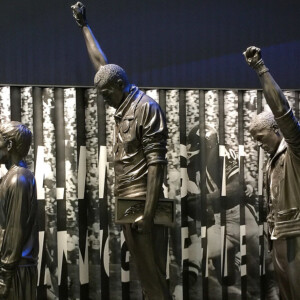
Jamison: Tommy Smith and John Carlos bowed their heads and raised black gloved fists during the US national anthem at the 1968 Olympics in Mexico City when each won a gold and bronze in the 200 meter running event. Many considered the move a salute to black power, but in his memoir, Smith indicated it was a salute to human rights. To this day, it is considered the most controversial political statement ever made during an Olympics, so much so that, because of recent peaceful protests for racial justice, the International Olympic Committee banned any form of protest connected to Black Lives Matter during the 2021 Summer Olympics.
00;01;51;27 - 00;01;58;24
J.R. Jamison
Violations could lead to athletes being stripped of their medals, but each instance will be handled on a case by case basis.
00;01;58;27 - 00;02;13;16
Kelsey Timmerman
Timmerman: Serena Williams speaks out against gender pay inequality and poverty. She has been criticized for not focusing on tennis enough, to which she responded, “The day I stopped fighting for equality and for people that look like you and me will be the day I'm in my grave.”
00;02;13;19 - 00;02;38;06
J.R. Jamison
Jamison: Colin Kaepernick remained seated in 2016 during the Star-Spangled banner to peacefully protest racial injustice, police brutality and systematic oppression. After much backlash, he opted to continue the silent protests throughout the season by taking a knee each time the song played. Kaepernick said, “The stand wasn't because I feel like I'm being put down in any kind of way. This is because I'm seeing things happen to people that don't have a voice.
00;02;38;08 - 00;02;45;19
J.R. Jamison
People that don't have a platform to talk and have their voices heard and affect change. So I'm in the position where I can do that.”
00;02;45;21 - 00;03;08;03
Kelsey Timmerman
Timmerman: When LeBron James criticizes President Trump, Fox News host Laura Ingraham said, “No one voted for you. So keep the political commentary to yourself. Or as someone once said, shut up and dribble.” James responded, “I mean too much to so many kids that feel like they don't have a way out, and they need someone to help lead them out of the situation there in.”
00;03;08;06 - 00;03;22;25
J.R. Jamison
Jamison: On today's episode, we feature two stories from athletes who stood up and spoke out. The first story is from Jesse Bates III, an all pro safety for the Cincinnati Bengals who seeks to fight racial inequality through helping moms and kids.
00;03;22;27 - 00;03;41;10
Mitchell Carter
Carter: The car hit a snowbank and stop in its tracks. A half mile away from the side of the shooting, Anderson Retic and Joshua Cole Cooper lay slumped in their seats dead. Jaylin Rice was in critical condition. These three young black men were gunned down after an argument with Joseph Bossard, a white man, inside of a gas station in my hometown of Fort Wayne, Indiana.
00;03;41;12 - 00;03;56;21
Mitchell Carter
Empty bullet casings littered the gas station parking lot, and blood spattered the inside of the car the boys were driving in to escape. I don't live in Fort Wayne anymore, but my mom does, and so do my siblings and many of my close friends. That shooting broke my heart. Those young black men could have easily been my friends and me.
00;03;56;24 - 00;04;12;05
Mitchell Carter
I believe that it was a hate crime, and that's not the Fort Wayne that I know. While I had no father figure in the home growing up, I had mentors, people close to me who were responsible for leading me on the right path. Not just in the football sense, but in life, too. Football is a game of inches.
00;04;12;06 - 00;04;34;11
Mitchell Carter
It's violent, but it's also strategic. Football, basketball and baseball were all sports that my mom put me in when I was a kid. I made a lot of friends and found that I excelled in all of them, but it was pretty apparent that football was what I had the best chance for a future in. I was a young man growing up in a single parent household, and the opportunity to continue my football career in college with a scholarship was one that I couldn't wait to jump up.
00;04;34;16 - 00;04;56;21
Mitchell Carter
I wasn't aware of just how many doors would be open for me through football, and for that I owe football a lot. Social justice isn't as cut and dry as football. You can't watch tape and scout social justice, and you don't need to get your ankles taped up before you take on social justice. Things that have been making headlines in our country - police brutality, racism, equality issues - those have been going on for years and years.
00;04;56;29 - 00;05;13;18
Mitchell Carter
It's just now coming up on a lot of people's radars, though, and while there is change being made I think that's great, I feel that everything that has happened boils down just to human rights. Speaking about what happened in Fort Wayne, those three boys were gunned down in their hometown, and I really do believe that if they were white, we wouldn't have seen them on the news.
00;05;13;23 - 00;05;30;13
Mitchell Carter
Besides an argument, nothing would have happened. Those young men were gunned down by a white man because they were black. It's a hate crime. Simple as that. If we can't eliminate things like that in our society, how much progress are we really making? When it comes to speaking out on social justice, there are so many things that are important to me.
00;05;30;16 - 00;05;43;11
Mitchell Carter
I know that I'm not alone in my thoughts about racial injustice, police brutality, and human rights, but I'll be the first to admit that I probably haven't been as outspoken as I would have liked to be. I feel like this generation is all about the hype, and it's cool to get behind what issues are hot in the moment.
00;05;43;12 - 00;06;02;17
Mitchell Carter
I think it's more important to be educated on a subject before speaking on it. First educate yourself, then educate your family and friends. That's where you're really gonna be making a difference. A lot of my focus has gone toward educating myself and my family and less towards speaking out publicly about issues, but I'm looking to change that as I grow and mature as a person and an athlete.
00;06;02;20 - 00;06;23;22
Mitchell Carter
When I was in high school, I was a part of AWP, Athletes With Purpose. Their mission was to develop not only the body of athletes, but also the mind. We worked hard, competing day in and day out in drills, workouts and sometimes seven on seven competitions. At the same time, though, all of those who were a part of AWP were taught lessons about how to be better men, not just better athletes.
00;06;23;24 - 00;06;42;08
Mitchell Carter
I strive to be just that: an athlete with purpose. I think we have a major problem as a society where we ostracize athletes who utilize their platforms to speak up on issues that are important to them. How can you tell somebody who's a person just like you are, to “just shut up and dribble?” We hurt too. We have opinions and fears just like the rest of you.
00;06;42;10 - 00;06;56;13
Mitchell Carter
That's where I feel like AWP really helped me grow, not only as a person, but as a player. You can't fix everything that's wrong with the world, but if you have the courage and passion to stand up and speak on an issue that's important to you, you can at least make a start. Growing up without a father figure in the home,
00;06;56;15 - 00;07;14;10
Mitchell Carter
I sought out the help and guidance of Michael V. Ledo, the CEO of AWP and now the CEO of RISE Sports Advisors. He was always pushing me. He saw the potential in me, but he also constantly reminded me that all the potential in the world means nothing if you don't continue to apply yourself every single day, especially when it comes to educating yourself.
00;07;14;12 - 00;07;34;09
Mitchell Carter
He was always in touch with me throughout college, and he’s still educating me to this day. He's an integral part of my management team now in the NFL, and he, along with some others, are the ones who ensure that I have both the financial and physical plan for myself on and off the field. One of the big problems about growing up with only your mom in the home is just lack of education about things that fathers talk about with their sons.
00;07;34;12 - 00;07;54;11
Mitchell Carter
I don't think there's enough we can do to push education with younger generations, especially those kids who are growing up just like I did. I've been in the league for a few years now, and I decided the best way to utilize my resources and my drive to give back to my community was to start the JB3 Single Mothers initiative, as well as creating some JB3 summits in my hometown of Fort Wayne. Through my Single Mothers initiative,
00;07;54;11 - 00;08;08;01
Mitchell Carter
I've gotten to partner with the Boys and Girls Club in Cincinnati and bring some kids and their mothers to a Bengals game followed by dinner with me. It'd be really easy for me to just throw some money at a program or a charity and call it good, but I think there's merit letting the kids see your face, talk with you and have an experience
00;08;08;01 - 00;08;26;08
Mitchell Carter
they'll never forget. Sitting down with those kids and their moms, seeing them all smile, laugh, and enjoy themselves is why I do it. I want those kids to see somebody who grew up not so different from them and made it. I'm not entirely sure where I'll go from here, but I love where it heading. I tried to apply the same principles in my JB3 summits.
00;08;26;10 - 00;08;42;09
Mitchell Carter
Unfortunately, due to COVID-19, we didn't get to have one this year, but the plan was to have a bunch of guest speakers come in with me and partner with the Fort Wayne Community Schools and just talk with them. There were so many things I had no idea about growing up: stocks and bonds, personal finance, and even sex.
00;08;42;12 - 00;08;56;20
Mitchell Carter
It's so important to me to give these kids the opportunity to be educated on subjects at a young age that I wasn't able to learn about until I was older, some of it not until I was out of college. I won't pretend to act like I'm a father figure to these kids, but maybe I can offer up some lessons that a father should.
00;08;56;22 - 00;09;11;29
Mitchell Carter
The same thing applies to the JB3 Summits as does my Single Mothers initiative. There's power in these kids getting to see me to interact with me. I was in a lot of their shoes not long ago, and I think just knowing that I have the opportunity and power to make a difference is what gets me the most excited.
00;09;12;01 - 00;09;28;15
Mitchell Carter
Football has opened up doors and opportunities for me that I never would have thought possible. I didn't come from money, and there's people just like me who haven't gotten and may never get the opportunities that I have. I'm not blind to the fact that I've been incredibly blessed, and I feel it's my opportunity to continue providing for my family and educating not only myself, but those close to me.
00;09;28;17 - 00;09;44;16
Mitchell Carter
Our country has been around for a long time, and the only way that we're going to continue moving forward and battling injustices is for us to all take a step back and understand what's really at hand and what we can do to change it. [Upbeat chill electronic dance music]
00;09;44;18 - 00;09;57;12
Kelsey Timmerman
Timmerman: Our next story is from Trey Moses, a basketball player who found and lost a friend through a struggle with mental health. We want to give you a heads up: this story involves a suicide. Listener discretion advised.
00;09;57;14 - 00;10;18;20
Thomas Deckard
Deckard: I remember just looking over at Zach smiling and laughing. I thought, wow, this is the happiest I'd ever seen him. It was my 20th birthday party, and I was thinking things we're starting to change, and he was starting to take that next step. Honestly, that's what made my entire birthday, seeing his happiness. To see all my close friends there and to see him smiling.
00;10;18;21 - 00;10;41;28
Thomas Deckard
One of those smiles that lights up a room. It was just amazing to see. That night made what happened next so much more difficult. The next day, I woke up to four missed calls and two voicemails from Zach. In a rush to get to my morning classes, I decided to hold off on listening to them and stop by Zach's after class. When I got to his place,
00;10;41;29 - 00;11;03;26
Thomas Deckard
it was there I discovered he had taken his life. It was jarring how my life changed in under 24 hours. The night before, he had seemed so happy. He had had a rough time in the past, and it had taken a toll on his mental health, which is why his happiness the night prior had made my entire evening.
00;11;03;28 - 00;11;31;04
Thomas Deckard
Mental health struggles were something he and I shared, especially after my clinical diagnosis my freshman year at Ball State. I had known he struggled himself, and my openness with my own struggles allowed him to have someone to talk to, and we were able to form a bond tighter than the one we had on the basketball court. It wasn't until the last 6 to 8 months of his life that I noticed he was struggling a little more than he'd originally let on.
00;11;31;06 - 00;11;54;16
Thomas Deckard
Personally, I think depression and anxiety can vary. Am I just sad? Am I just waking up sad today? Am I just nervous about this or that? I feel that he may have just not truly known what was going on, and having some personal issues of his own only added into that struggle. In May of my sophomore year, I had tried to take my own life.
00;11;54;18 - 00;12;14;23
Thomas Deckard
A few days after, Zach asked me why I hadn't told him how I was feeling. I told him I should have talked to him about it, and it honestly made me feel bad that I hadn't shared how I had been feeling. Then on the night he took his life, I'd received those missed calls and voicemails, and it left me with a sense of regret.
00;12;14;26 - 00;12;44;18
Thomas Deckard
He had reached out, and I just wasn't there. It was hard for me to deal with that weight then, and sometimes I still deal with it now. It's just I need to understand that I shouldn't beat myself up over it. We had a coach that would say, “We'd walk barefoot to Alaska and back to have Zach back.” That applies to me personally, because I would do whatever to be able to go back and answer one of those calls.
00;12;44;20 - 00;13;10;02
Thomas Deckard
Sharing all these personal issues, our friendship only grew. I made it my mission after he took his life to dedicate everything I did in his honor. I felt it was my responsibility, especially after what he said in those voicemails. When I listened to them, I heard a constant message of what he wanted me to be. He wanted me to be successful in basketball.
00;13;10;05 - 00;13;32;21
Thomas Deckard
He wanted me to be successful in life. I think the biggest thing I took away is I could relate to the pain he was feeling. I could hear it. Through those voicemails, I could feel what he was going through. It was tough to hear. Once again, if I had answered the phone, I wonder if he'd still be here today.
00;13;32;23 - 00;13;57;14
Thomas Deckard
I've kind of gotten over that stage. My biggest takeaway from it was hearing how much he loved me, how much he cared about me, how much he wanted me to be successful in life and on the court, and how much he wanted me to keep going no matter what. It was also understanding that life isn't easy, but it's so much better with people who truly love and care about you.
00;13;57;16 - 00;14;24;28
Thomas Deckard
I know he's one person that genuinely loved and cared about me, no matter what I did for him. I changed my basketball number from 41 to his 24, and got a tattoo on my finger of 241, a combination of both our numbers to honor him. I started a foundation, 24 Reasons, dedicated to mental health awareness and accepting your issues and learning to live with them.
00;14;25;01 - 00;14;47;07
Thomas Deckard
One of the favorite things about my foundation is how much I've been able to help others. I love it when someone reaches out to me and says they've been struggling recently, but then they see their 24 Reasons shirt or bracelet, and they'll be reminded to keep going and that it's okay not to be okay. Through my foundation, I hope to inspire people to find their own reasons.
00;14;47;07 - 00;15;12;15
Thomas Deckard
And if they can't, they can always reach out to me, to reach out to anyone, for help. The biggest thing I always say is, “It's okay not to be okay, because that's better than not being here.” I feel over time that mental health has been an issue many men have been taught not to speak about and to keep quiet.
00;15;12;17 - 00;15;40;11
Thomas Deckard
It comes from a mindset of previous generations to just shrug it off. There was the attitude that men aren't allowed to cry that has created a stigma around this topic. A lot of these ideals have been taught to both men and women in sports through the mindsets of the coaches. The influence they hold sort of ingrains the young athletes and people in general to not show weakness or vulnerability and to just power through it all.
00;15;40;14 - 00;16;08;03
Thomas Deckard
Fortunately, though, you now have men and women both speaking out on these topics and vocalizing that it is okay to talk about these types of issues. Talking about it, and allowing the younger generations to see that it is okay to feel a certain way, allows the deconstruction of the stigma around mental health. I feel that so many people are in denial, and acceptance is crucial to dealing with mental health issues.
00;16;08;05 - 00;16;32;25
Thomas Deckard
I remember through high school I hadn't heard about anyone taking their own life or being depressed. But as I got older, that changed. My freshman year, I saw stuff on Twitter about depression, and I thought to myself, there's no way. That's not what I'm going through. Not me. Sure, I've been sad, I've cried. But that's not me. I don't have these issues.
00;16;32;27 - 00;16;56;24
Thomas Deckard
Then I got diagnosed with depression, and it changed to, maybe this is me. Maybe this is what I'm going through. I feel that the hardest yet most important part is admitting and accepting your own issues. Then I feel the next step is sharing your issues with those closest to you. I have my own way of sharing my issues, and your way
00;16;56;25 - 00;17;38;18
Thomas Deckard
may be different, but it is still important to share with those important to you. We all need people. We are all put here to love and care for others. So I feel, after personal acceptance, sharing with those around you about your issues is incredibly important. Once you're able to accept and share your issues, you're going to find it much easier to find your reasons to keep going. [Upbeat chill electronic dance music]
00;17;38;20 - 00;17;43;20
Kelsey Timmerman
Timmerman: Now we are joined by Trey Moses. Trey, welcome to the Facing Project. I'm so glad you are here.
00;17;43;22 - 00;17;45;22
Trey Moses
Moses: Yeah, thank you for having me on.
00;17;45;25 - 00;18;03;25
Kelsey Timmerman
Timmerman: So, you know, we just heard your story. Powerful story. So thankful that you use your voice and share your story regularly. When was the first time that you realized that your status as an athlete gave you a platform from which to be heard?
00;18;03;27 - 00;18;24;14
Trey Moses
Moses: I would probably say my freshman year in college is, you know, I kind of became more open about the things that I was going through. And it was more so on Twitter, but it was just one of those things where I realized, like, people were paying attention. People were,
00;18;24;16 - 00;18;44;27
Trey Moses
you know, reaching out if they needed something, or I would tweet something and, you know, it would it would be retweeted, you know, a couple of times, it's like, okay, there's other people going through, you know, kind of what I'm going through. So I need to, you know, try to use my voice to help others and to be open about what I'm going through.
00;18;44;29 - 00;19;03;12
Trey Moses
And I'm very thankful that, you know, I have the platform I do, but I think it was around my freshman year of college where I really realized that I have the ability to help others in mental health aspects.
00;19;03;14 - 00;19;16;10
Kelsey Timmerman
Timmerman: So is that an awkward first step to kind of come out like that, decide this is something I'm going to share on a, not just with family and friends, but like, very publicly?
00;19;16;13 - 00;19;44;24
Trey Moses
Moses: I mean, yeah, what’s crazy is, you know, a lot of my family didn't even know. So, I mean, really, my mom and dad had found out three days before I left for college. It was something that I just hadn't talked about. You know, there's that stigma around mental health, and especially with athletes, black athletes, black male athletes.
00;19;44;26 - 00;20;04;08
Trey Moses
So I think it just made it tough for me to want to open up. And I didn't even know what I was going through. You know, my freshman year, I was diagnosed as having severe depression. And I think, you know, I was like, wow, like, okay, like, this is why I was feeling that way? But it's like we were not- we weren't taught this in school.
00;20;04;08 - 00;20;19;09
Trey Moses
We weren't taught the signs of, of what to look for in ourselves. We weren't taught anything about mental health. But I would say yes, it was awkward, but I'm glad I did it that way because I feel like I've been able to help a lot of people by using my voice.
00;20;19;11 - 00;20;32;25
Kelsey Timmerman
Timmerman: And so that first time that you started to share on Twitter, what was the- what were the response, like, positive and negative, or were there any pos- negative that came from that or was overwhelmingly positive?
00;20;32;27 - 00;20;51;26
Trey Moses
Moses: You know, there's- it wasn't that I came out with just like, you know, this is what I'm going through, but it was more of like a, you know, just some tweets here and there and just trying to tell people they're not alone or try to just be there for people. You know, that's always how I've been in general.
00;20;51;27 - 00;21;22;27
Trey Moses
I get it from my mom, but I just think it's one of those things where a lot of positives have come out of it and came out of it. Obviously there's negatives. No matter what you do, you could give someone $100 on the streets and, you know, someone, somewhere is going to talk about, why don't you give 200? Why didn’t you give them 300? You know? And so for me, I would say the negatives were just, you know, maybe people saying I’m
00;21;22;29 - 00;21;45;13
Trey Moses
just doing it for attention. And I think as someone who deals with mental health, like, that's like the worst thing to hear because then it's like, okay, maybe I shouldn't open up, maybe I should be quiet about what I'm going through. And so I've battled that a lot in general, but I would say that's probably like the only negative.
00;21;45;20 - 00;21;56;21
Kelsey Timmerman
Timmerman: So how do you recognize when you are struggling with your mental health, and like, what do you do next? And what do you tell others to do who have that same struggle?
00;21;56;23 - 00;22;27;16
Trey Moses
Moses: For me, I think it's just something- it's just kind of like a feeling, like, I just feel like I've been stuck in the same place. And that's kind of my big thing right now is, just feeling like I'm stuck. And so I try to do stuff that, for one, I try to get a routine. Waking up in the morning, I'm showering, I'm writing in my journal and making breakfast to try to start my day off in a positive way.
00;22;27;17 - 00;22;49;22
Trey Moses
Even if I'm writing something in my journal about something negative, it's- I'm trying to start off in a positive direction by kind of getting it all out there. And so in that sense, I think that's helped me out a lot. But when I feel like I'm starting to get down on myself or get down in general, I'm very open and- about the things that I go through.
00;22;49;22 - 00;23;15;14
Trey Moses
So a lot of the times I'll just tell one of my friends, like, “I'm really struggling.” And so I'm blessed with really good friends, very thankful for them. And at times I don't know why I'm struggling. And that's kind of the, you know, the, the mental- or the depression. You know, that's how it can be sometimes. But I kind of take that next step and just open up to my friends.
00;23;15;14 - 00;23;35;12
Trey Moses
And from there I'm able to talk to them where they're able to say, “Hey, you want to just come hang out and just sit? We don't even got to talk about anything.” But that's what I would kind of say. I know a lot of people have trouble opening it up or kind of telling friends that. You know, I've always said and I've been told, “Not everyone needs to know, just a few good people.”
00;23;35;13 - 00;23;44;02
Trey Moses
And so I think it's important that, you know, just one or two, two good people in your life to kind of open up to them.
00;23;44;05 - 00;23;56;01
Kelsey Timmerman
Timmerman: Do you feel like there has been a shift in this conversation that it is becoming more open, or do you feel like it's kind of where it was when you first started speaking out?
00;23;56;04 - 00;24;22;16
Trey Moses
Moses: No, I think the shift has been, you know, significant, like, to see athletes like Kevin Love, Kyle Guy, DeMar DeRozan, Michael Phelps, A’ja Wilson all opened up, and they’re, you know, top level athletes in their sport. It only helps. There's nothing negative that can come from that. And so now you're seeing more athletes open up and speak about it.
00;24;22;16 - 00;24;43;23
Trey Moses
You're seeing- I just got done some- done with doing something with the NCAA where I was hosting and talking to college athletes about their stories. And you're seeing the NCAA do something, you know, to help athletes out, to help athletes get their stories out. And for the non-athletes, you're seeing, you know, people just start to speak up in general,
00;24;43;24 - 00;25;02;00
Trey Moses
to go seek help. And I think the the stigma is starting to end. We still have a lot more to go because, you know, it's not just depression. There's a lot of different areas of mental health that need to be addressed, but we're slowly but surely getting there.
00;25;02;03 - 00;25;35;17
Kelsey Timmerman
Timmerman: Yeah. I mean, it seems like such an important conversation to have right now, especially after we're coming out of a pandemic and we've been isolated from one another. So one thing that strikes me from hearing your story is that one of Zach's last acts was to use his voice to give you reasons to go on. And I know with your group 24 Reasons, like, you're reminding yourself and others regularly of those reasons.
00;25;35;22 - 00;25;45;00
Kelsey Timmerman
So, like, what are some what are some of the reasons that, that you've turned to recently, and what are some reasons that you encourage others to seek out?
00;25;45;03 - 00;26;11;03
Trey Moses
Moses: For myself, it's you know, it's all about family. My family and friends have done so much for me. I wouldn't be here without them. You know, at my lowest moments, I- that's who I think about. And so they keep me going. My passion for what I do keeps me going and just wanting to become a better person for other people and become a better friend every single day.
00;26;11;04 - 00;26;38;00
Trey Moses
And, you know, it's- it can be tough at times to, to keep going. But for me, that's what keeps me going. And for other people, I would just say, you know, find what you love to do. Find the people you care about. And that that should be what keeps you going. It shouldn't be money. It shouldn't be, you know, anything else like that could be more worldly, I guess.
00;26;38;02 - 00;26;58;22
Trey Moses
Or, you know, like Christ followers. But for me, I mean, faith is another big thing for me that's kept me going. I gave my life to the Lord, you know, 4 or 5 months after Zach had passed away. And that helped me get through a lot of the worst times in my life. But, you know, that's kind of what keeps me going.
00;26;58;24 - 00;27;04;02
Trey Moses
You just gotta find kind of what you care about, what you love and what makes you happy.
00;27;04;04 - 00;27;19;26
Kelsey Timmerman
Timmerman: So what does your- as you, as you do this work with your organization and, and you're still playing basketball professionally, what does your day to day look like in terms of spreading this message?
00;27;19;28 - 00;27;47;09
Trey Moses
Moses: Yeah. So for me, Mondays are probably like, I know everyone hates Mondays, but Mondays are probably like my favorite day, because that's where I kind of do the most in terms of reaching out to people. So every Monday I, I post on Instagram, like, asking people how they're doing. I do, like, a poll, I say “Are you good, or unwell?” And in one of the corners I say, “Thank God for Mondays,” because a lot of people hate Mondays.
00;27;47;12 - 00;28;10;02
Trey Moses
It's easy to hate Monday. Like I feel like it's, you know, everyone does, but everyone who votes “unwell,” I check on them; I message them and have, you know, real conversations with them about what they're going through. And it's, it's all because I care about people. It's all because I want people to know that I'm not just listening, but I'm hearing. I'm- They’re being heard.
00;28;10;02 - 00;28;19;07
Trey Moses
And that's all I want to do is give people a chance to be heard, because they may not be feeling heard, and that a lot of times can drag you down even more.
00;28;19;09 - 00;28;24;08
Kelsey Timmerman
Timmerman: Can you share an example of a, of a conversation that that has led to?
00;28;24;10 - 00;28;48;02
Trey Moses
Moses: Yeah. So I've, I've actually made a couple of friends through it. But you know there's obviously the pandemic stuff, but there's you know, there's been someone who has lost their mom and voted “unwell.” There's been someone who had just lost their job. There's been someone who just had just a terrible weekend, or someone who woke up feeling super anxious.
00;28;48;05 - 00;29;09;12
Trey Moses
So those are kind of the, you know, the things I, I'm not going to say “get,” but those are kind of some of the conversations I've had that have kind of really stuck with me. But I try to just be as consistent as I can to, you know, to those people. And a lot of times I'll, I'll double back throughout the week and try to, you know, see how people are doing after that initial conversation.
00;29;09;17 - 00;29;20;04
Kelsey Timmerman
Timmerman: Well Trey, we appreciate your work. Keep it up. Thanks for joining us. And it's been a pleasure having you on. And thank you so much for sharing your story.
00;29;20;08 - 00;29;22;15
Trey Moses
Moses: Yeah. Thank you for having me on.
00;29;22;17 - 00;29;31;29
J.R. Jamison
Jamison: Trey and Jesse, like many athletes before them, did more than just speak out. They acted. They backed their words with real world actions that make an impact.
00;29;32;02 - 00;29;55;25
Kelsey Timmerman
Timmerman: For sure. Like, I'm wondering, if we tell athletes they are supposed to “shut up and dribble,” who is allowed to speak out? Like what job or educational requirements must one have to speak against injustice or foreign issue? I mean, what requirement does your very opinionated uncle have that people aren't telling him to shut up and middle manage? These stories, and the Facing Project in general,
00;29;55;26 - 00;30;18;19
Kelsey Timmerman
show us that there aren't requirements. Sometimes life puts us in a moment, and it's our time to stand and to speak. [Theme music]
00;30;18;22 - 00;30;35;28
J.R. Jamison
Jamison: The stories used in this episode were originally published in Facing Social Justice in Sports led by Dr. Adam Kuban at Ball State University. Mitchell Carter played Jessie Bates III, with story by Jessie Bates III and Mitchell Carter. Thomas Deckard played Trey Moses, with story by Trey Moses and Thomas Deckard.
00;30;36;01 - 00;30;59;03
Kelsey Timmerman
Timmerman: To listen to past episodes of this program, visit IndianaPublicRadio.org/TheFacingProject. From there, you can subscribe to the podcast where you'll get the project delivered to your device each month. Listeners can contribute stories or volunteer to share the stories of others with the Facing Project that may appear on the show. More information at FacingProject.com/InspireAction, and to continue the conversation about this episode,
00;30;59;04 - 00;31;01;20
Kelsey Timmerman
find us on Facebook at The Facing Project.
00;31;01;21 - 00;31;22;19
J.R. Jamison
The Facing Project is recorded at Indiana Public Radio at Ball State University in beautiful Muncie, Indiana, and is produced by the amazing producer extraordinaire Sean Ashcraft. The show is distributed nationally through PRX. We’re your host, Kelsey Timmerman and J.R. Jamison. And until next time, we wish you the courage to share your own story and the empathy to listen to others. [Theme music ends]