Amelia Earhart search team says object in satellite image was likely trees, not plane wreckage

The nearly 90-year mystery of Amelia Earhart’s disappearance continues. A joint expedition involving Purdue University concluded that an object spotted in satellite images was likely a collection of large trees, not the wreckage of her plane.
The team had hypothesized that a visual anomaly, known as the Taraia Object, first seen in 2020 satellite images of an island lagoon in the Pacific Ocean, was wreckage of Earhart’s Lockheed Electra 10-E. The team spent seven days near Nikumaroro island, including four onshore. The island is an atoll, a ring-shaped coral reef that encircles a body of water.
By the time the team arrived there, a “good portion” of the object at the Taraia Peninsula had broken up and washed away, leaving a Y-shaped segment, a fraction of the object’s size in the images, according to a Purdue news release.
Earhart and navigator Fred Noonan disappeared somewhere in the Pacific Ocean near the end of their trip around the world in 1937. The plane, known as the “Flying Laboratory,” was funded by Purdue Research Foundation and was supposed to be returned to the university when Earhart completed her trip.
The 17-member Taraia Object expedition was a joint effort among the Archaeological Legacy Institute, Purdue Research Foundation and Purdue University.
Purdue general counsel and expedition member Steve Schultz said the team left the island with more knowledge than when they arrived.
“We have always said this was a scientific endeavor. We followed scientific methods to test the hypothesis, and we’ve ruled out one hypothesis,” Schultz said in a video released Sunday. “Unfortunately, we weren’t able to find that smoking gun.”
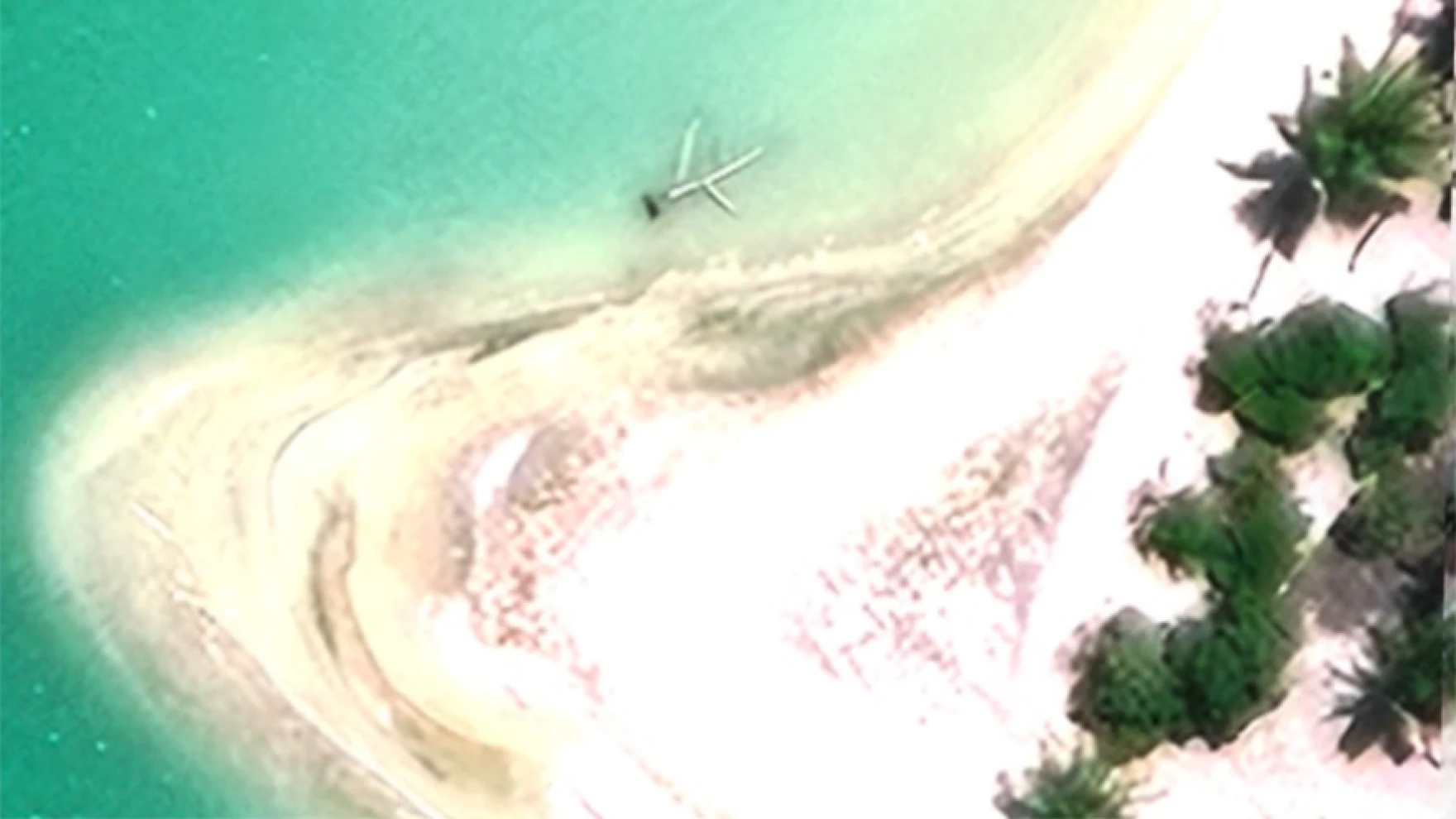
The team said it found several artifacts including a steel tube 30 inches long that will be further studied to understand how objects entering the lagoon through the channel on the atoll’s western side can drift across it and wash up on the Taraia Peninsula.
Researchers still believe that Earhart and Noonan landed on the reef flat around the island and were marooned there, said Archaeological Legacy Institute Executive Director Rick Pettigrew. The theory is supported by human bones and artifacts found over the years on the island, as well as radio bearings recorded from transmissions at the time by the U.S. Navy, the U.S. Coast Guard.
“The island has been holding on to its secrets, and it continues to do so. I think eventually someone will find conclusive evidence here to finally put a cap on the mystery,” Pettigrew said in the video. “But for now, we are happy that we were able to accomplish what we did, and we’ll go away proud of the accomplishment.”
The Taraia Object expedition launched from Tarawa in the Republic of Kiribati on Oct. 6.
Contact WFYI reporter Samantha Horton at shorton@wfyi.org.
