S03 E20 – We’re in Cowboy Couture
Listen

Audio Transcript
[Sean Ashcraft] Support for Pop of Culture comes from Stallings Wealth Management. Daniel Stallings Financial Advisor, Securities and Advisory Services offered through Cetera Advisors, LLC. Member FINRA/SIPC, a broker/dealer and registered investment advisor. Cetera is under separate ownership from any other named entity.
[Michelle Kinsey] This week on Pop of Culture, we go country, stylishly.
[Jerry Lee Atwood] These are functional pieces of clothing besides being a canvas for embroidery and rhinestones.
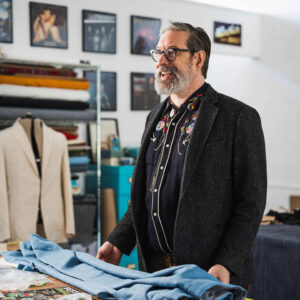
[Kara DuQuette] A new exhibition shows off the cowboy couture of Hoosier fashion designer, Jerry Lee Atwood.
[Michelle] We'll also learn about new public art in downtown Muncie.
[Kara] And we say goodbye to one of our Pop team members. Stay with us.
[Luke Jones] Support for Pop of Culture comes from Stallings Wealth Management and from you. You may have heard about large gifts to NPR. Those donations are important, but they don't bring back the funding to IPR. Your support pays for the programs you rely on, especially local programs like this one, and the people like me who create them. Pop of Culture exists for you and because of you. Give today at indianapublicradio.org.
[Michelle] From Indiana Public Radio, this is Pop of Culture. I'm Michelle Kinsey.
[Kara] And I'm Cara DuQuette.
Coming up, we'll head to Downtown Muncie for a singing competition and to talk about new public art on display. But before that, Michelle, have you noticed a cowboy current running through the culture in the last few years?
[Michelle] You know what? I have. There have been a lot of TV shows like "Yellowstone," right? And movies. What was that movie?
[Kara] Have you seen "The Madison?"
[Michelle] No.
[Kara] That's also got that vibe.
[Michelle] Yeah, "Killers of the Flower Moon." [Kara] Yep.
[Michelle] What else? Oh, music?
Yeah, a lot of crossover stuff, Cowboy Carter. [Kara] Sabrina Carpenter.
[Michelle] Yes, a lot.
Yeah, it seems, yeah. Everybody's got their boots on. [Kara] They do, indeed. [LAUGHTER] And Union Western. This is a brand co founded by fashion designer Jerry Lee Atwood. And if you don't know either of those names, you have seen his work on the red carpet. And now you can see it at the Eiteljorg Museum in Indianapolis. Jerry joins us from Indy. Thanks for talking with us today.
[Jerry] Absolutely.
[Kara] Jerry, I'm interested to know what led you to be a fashion designer. [Jerry] Well, you know, it was not something I expected to ever end up doing. [Kara] Ah.
[Jerry] I had worked in I was an art school dropout,
and I was working in a coffee shop or, you know, specifically a coffee shop here in Indianapolis. And, you know, the joke I always make is that I could work in a coffee shop without the art degree.
And, you know, everyone I knew that worked in a coffee shop or everyone I knew that had an art degree, worked in a coffee shop or had some job that wasn't really related to art. And so I just decided to go out on my own and find my own path. And, you know, I was always into drawing and painting and printmaking. And then I kind of stumbled into the art of hand embroidery. [Kara] Ah.
[Jerry] And I just always liked,
you know, textiles and
always enjoyed seeing embroidery and thought, you know, I should try it sometime. [Kara] Now, did you initially embroider on clothes or.
[Jerry] No,
no, I was just, you know, I had an embroidery hoop and would buy fabric and just embroidery floss and just do these little hand embroideries, just turning drawings that I had done into embroidery.
And, you know, I would have all these little pieces of embroidery, and I didn't really know what to do with them. But I had a customer come in one day who had bought a book at Half Price Books about the history of Western wear. [Kara] Mm.
[Jerry] And he said, You know,
"I think you'd really love seeing," you know, "the embroidery." And so, you know, flipping through this book brought back a lot of nostalgia of going to Nashville with my parents when I was a kid and, you know, always watched "Hee Haw" at my grandma's house on the weekends on Sunday.
And my parents were square dancers for a while. So it kind of brought back a lot of nostalgia. It was never something I particularly enjoyed seeing, to be honest. But, you know, when I was like I said, when I was looking through this book, it did bring back the nostalgia of that time in my life and seeing Western wear and seeing this type of clothing. And I just thought it would be fun
you know, quote unquote fun to try to make my own fancy Western shirt. And that just kind of took me down the rabbit hole of learning about sewing and learning about
fashion. And, you know, I started out fairly simple, learning how to make, you know, a shirt with piping. And then, you know, when I felt like I was pretty good at that, it became trying to figure out how to make pants and then figuring out how to make a suit jacket. [Kara] Mm hm.
[Jerry] And I just always loved that process of discovery.
And being out of my comfort zone and
trying to learn something new and trying to master something new. [Kara] Yeah, like a challenge.
[Jerry] Mm hmm.
Absolutely, yeah.
[Kara] I can totally relate to that.
I wanted to know what are some of the things that inspire you in the cultural realm that we were talking about. We know it's not square dancing, what's some of the imagery? Can you walk us through some of the things you'd like to create with your cowboy couture? [Jerry] Well, you know, since I'm always working with different customers,
you know, most of them want something that's a little bit more relevant to their own life. And a lot of times, you know, Western suits that have a lot of embroidery that are pictorial are kind of referred to as story suits because they're telling the story of the person wearing them. So as far as motifs that I gravitate towards,
you know, there's a lot of things that I've discovered on this journey, I guess. You know, I've had customers who are really into space. You know, one of my favorite suits was a suit that I made for a customer named Robert Ellis. You know, he loves, you know, the culture of NASA and space in Houston. So, you know, and I've done a couple suits since then that have been space themed, whether it's.
[Kara] Nice.
[Jerry] Aliens, you know, quote unquote, abducting
guitars. So, you know, I would say there's not, like, one particular theme that I always gravitate towards, but,.
[Kara] Mm hmm.
[Jerry] You know,
that's one in particular that I've enjoyed doing. [Kara] Well, I appreciate you sharing that, and you've made quite a case for working on your art in public when you were in your coffee shop.
[Jerry] Oh, yeah.
[Kara] 'Cause it led you here in a lot of ways. So, did you ever imagine you would have a solo show at a museum, like the Eiteljorg?
[Jerry] No, you know, since I gained a little bit of notoriety, I imagined that at some point, I would have a show, but, you know, when I started doing this, almost 20 years ago, or I guess, more than 20 years ago, at this point, you know, no, I never I just imagined I would be working, um
coffee shop jobs or working, you know, probably not a job, not having a career in the arts. I didn't really think that would be something I would end up doing. [Kara] Well, do you view your clothing as art? Because I was thinking maybe you'd think, Oh, I'm working in the clothing industry, but then to take it to another level of museum display is just really interesting, I find. [Jerry] Yeah, you know, that's something a lot of people ask me about, you know, how where does where does clothing? Where does fashion fit into art?
And I think in the past couple decades, we've seen a lot of a lot of fashion designers cross that bridge or, you know, cross that divide, I guess. You know, Alexander McQueen is probably the um,
one that comes to mind. Like, you can't look at Alexander McQueen's work as anything other than art. [Kara] I feel that way about Schiaparelli as well. [Jerry] Oh, absolutely. Yeah, yeah. And I've always been kind of proud of living in both worlds, I guess. [Kara] Oh, yeah, that's the best. How did you pick how did you pick items for your show? [Jerry] Well, you know, that was, um,
a long a long time in the making, we had started talking I started talking to the Eiteljorg almost five years ago. [Kara] Wow.
[Jerry] So there were a lot of moving parts,
you know, a lot of it that I wasn't necessarily involved in. [Kara] Oh, sure.
[Jerry] But from my end,
it was reaching out to my old customers and, uh,
getting them to agree to let their, you know, precious suits go. A lot of them had them, you know, either on display somewhere in their homes or still wear them, so.
[Kara] Does it feel odd to you to have
the suits on display rather than seeing them worn? [Jerry] No, you know, obviously, it's always great to see photos that my customers send me of them in their suits and
you know, and I've had an opportunity to see a few musicians that I've made stuff for actually wear them in person, which is always really cool. But no, you know, it's really cool to be able to see to be able to walk into the Eiteljorg exhibit and see these pieces on mannequins and see them displayed as, you know, as art pieces, you know, and obviously, they're meant to be worn. [Kara] Mm hmm.
[Jerry] And the way that they've presented the suits,
you know, they were really conscientious about the lighting. So when you walk around, you know, these are all pieces that are covered in rhinestone. So when you walk around,
you see the movement, you see the sparkling of the rhinestones. And so I think you still get the experience of envisioning them on a person, but being able to take the time to kind of look all around them and see all the detail and all the work and not just the embroidery and the hindstones but also the tailoring.
You know, these are functional pieces of clothing besides being a canvas for embroidery and rhinestones. [Kara] Now, can we expect to see the suit that you made for "Old Town Road?" [Jerry} Well, no, you know, that one is that one is on display currently at the Country Music Hall of Fame.
[Kara] Oh, okay.
[Jerry] And it's they've said that it's a pretty popular attraction at the Hall of Fame. So that was one that they were not able to get. And a lot of the high profile stuff,
you know, there's a lot of artist management and all that that.
[Kara] Sure.
[Jerry] There's a couple pieces. Like, there's a suit that was made for Beth Ditto, who is the singer of a band called The Gossip.
And she was in a show on Fox called, "Monarch," and I made a suit for her. And so that's on display. And then there's a voice actress named Grey DeLisle, who has voiced characters from "The Simpsons," "King of the Hill," she's been the voice of Daphne from "Scooby Doo" for the last 20 years.
And I made a couple pieces for her, including what I call the prairie dog dress. So that's on display. And then there's an outfit that I made for a singer named Sierra Ferrell, and, of course, Sierra Ferrell will be known to Americana fans. She's a rising star in the, you know, Country-Americana scene.
But there are, you know, there are original sketches in the show for the "Old Town Road" suit. [Kara].Mmm.
[Jerry] A couple of original sketches
for pieces I've made for Post Malone. So there are things to see that, you know, that are in that celebrity sphere. [Kara] Now that you have this solo exhibition of I don't know, your life's work, what's next for you?
[Jerry] What's next? Oh, my gosh. Uh, that's a tough question, you know?
[Kara] You don't have to know.
[Jerry] I mean, there's a couple of things that I've made that I can't really talk about, that.
[Kara] Oh.
[Jerry] Will potentially be seen within the next, or within this year for, you know, pretty pretty well known celebrities. Um,
you know, I'm always kind of, like, living in the moment. I'm kind of just making what's, you know, what I have orders for, and, you know, I feel very fortunate to have had the opportunities that I've had. And, you know, I'm always living in the present, I guess. [Kara] Yeah, with an eye to the future, right? That's that's.
[Jerry] Oh, sure, absolutely.
[Kara] Well, thank you so much for sharing with us, Jerry, and being in this moment with us. I appreciate it.
[Jerry] Yeah, absolutely.
Thanks for taking the time to talk to me.
[Kara] Jerry Lee Atwood is a fashion designer in Indianapolis, and he has a new exhibition at the Eiteljorg in Indy. It's called "Cowboy Couture: The Fashion of Jerry Atwood." It's on display through August 2.
You're listening to Pop of Culture. I'm Cara Duquette.
[Michelle] And I'm Michelle Kinsey.
Back in the Pop of Culture studios is India Potter. You may remember her as the DWNTWN Idol competition winner in 2025. India, welcome back.
[India] Hi, thanks for having me back.
[Michelle] She's back this time to encourage others to get involved in the 2026 competition, right?
[India] Mm hmm. Yep. I'm here to talk about how to audition and submit
your audition and how to participate.
[Michelle] I love that.
So first, let's go back in time a little bit. Tell us about your audition. What did you do to audition? What was the process like? 'Cause I'm assuming it's very similar to this year's.
[India] Last year,
they wanted you to go to certain places and, like, record a live performance in front of people. And so I did that at the Heorot their Open Mic Night. And I just did the song "Creep" because it's classic. And I just submitted that video. My friend Kaitlin helped me record it. And I got in the first round, which then got rained out. So it was supposed to be at Canan Commons, but then we had a Cornerstone, which was great because they have a wonderful stage there. And it was very fun. And then I had to wait till the final round. After that, I got through the final
they have a second round each year, and that's at Fire Up DWNTWN. That's another audition day. [Michelle] Yeah. Yeah. So kind of similar this year. So people are encouraged to submit auditions right now, but they don't have to do it in front of a live audience. [India] No.
[Michelle] They could just submit it in their home they want.
[India] Sing in your car. [Michelle] Sing in your car!
[India] Anywhere that's good for you.
[Michelle] And then those finalists, the first in-person kind of competition, right, is during Brink of Summer? [India] Yeah, Brink of Summer ArtsWalk, June 4 is the first round of auditions. And even if you don't make it in that round to the finals, you can submit again for the second round. [Michelle] Oh.
[India] To audition again.
[Michelle] And then the second round, is it at Fire Up? [India] Yeah, Fire Up DWNTWN the most fun festival Muncie has I think of the year. [Michelle] It is very fun. And then the finals will be during the fall ArtsWalk?
[India] Yes.
[Michelle] The October
[India] Yeah. The October 1 ArtsWalk.
at Canan Commons, depending on weather.
Last year, the finale, we were able to have it there, and it was very fun. The lineup was full.
[Michelle] Perfect night, a perfect night.
[India] Bring out your lawn chairs and just have a karaoke party. Cheer people on.
[Michelle] Other than bragging rights,
the winner of DWNTWN Idol does walk away with some pretty cool stuff, right?
[India] Yeah. So there is a cash prize.
And then I got a really cool trophy, which afterwards, I walked around downtown with and showed off.
[Michelle] Yes, you did. Yes, you did.
You had your photo taken in various locations. Yes.
[India] And you'll get to perform on
the next year's DWNTWN Idol performances and audition days. And then you'll get a photo shoot from Kishel Photography. She's an amazing photographer, and you get a makeover with Kara Leigh Robinson. And then you'll also get an overnight stay at the Courtyard by Marriott in Downtown Muncie.
[Michelle] Nice. And you've been able I mean, it comes with bragging rights. So I mean, a lot of times when India is introduced at various performances around town, It is mentioned. 2025 DWNTWN Idol winner, right? [India] I have three bands that I play with, and they joke about it a lot. And then I also host Open Mic nights now, so that helped me get that opportunity to host. [Michelle] So what tips would you give someone who is sitting there right now thinking:
"You know what? You know, I'm interested in this. I think I could do this." What tips would you give them as far as song choice and, you know, recording of their submission?
[India] Mm hmm.
[Michelle] Things like that.
[India] I would make it very clear it needs to be family friendly.
[Michelle] Mm hm.
[India] And if there's a version that is clean, you know, ask for that version specifically if you get chosen to audition.
Um, just try to pick a place that sounds good, a song that makes you feel confident and try to show off and practice your stage presence. So that's a really big part of it. You want it to be a song that's going to get the crowd excited and having fun and try to hype them up a little bit with you. That is a good way to win the audience over.
[Michelle] Yeah. And I know in particular "Creep" when you did "Creep," I mean, it really shows off your range. That is one of those songs that has a lot of dramatic moments. It shows, you know, a huge range, if you want it to. Was that were you very conscious of that when you were choosing the song, or did you just really like to perform?
[India] Um, yeah, I sing that song a lot if I'm, you know, out and about and people are like, Oh, sing a song for us. I'm like, I'll just do that because I know it very well and I'm comfortable and the way that I sing it really does show off my, like, my belting side and my falsetto side. Yeah, it does show off a range.
[Michelle] And I think you just hit on the key point for anybody listening that wants to audition is be comfortable with your choice. Don't do something, you know, you're just now learning. You've only done. You know, do something that, like you said, [India] Practice in front of your friends. [Michelle] Yes. That's a good point. You could even film your submission in front of your friends. You could have a little built-in audience. That's right. That's right. So where should people go for more information, India, on DWNTWN Idol?
[India] They can go to downtownmuncie.org/DWNTWN-Idol. And on there, you'll find all of the dates, answers to frequently asked questions, everything you can win, some pictures from last year's, and where to submit your audition form.
[Michelle] Perfect. And we should point out that the deadline for this kind of round of submissions and then for the opportunity to audition is the end of May. So, work on those songs. India, thank you so much for coming in and telling us all about this year's DWNTWN Idol. Looking forward to hearing you sing at the Brink of Summer ArtsWalk. [India] Yeah.
[Michelle] Anything else that we forgot or
we should mention about this opportunity? [India] Please be brave. [Michelle] Mm.
[India] Audition. We want to hear your voice,
and we're excited for all these submissions. [Michelle] Perfect. Thanks.
[Kara] Most of us have been to a convention center for one reason or another, a wedding, a trade show, or conference. And as you walked around the cavernous spaces, you may have seen empty walls and floor space. Or maybe you saw some generic art images that could be anywhere, but really put you in the mind of nowhere in particular. Well, we are here with two people who are working to make the Horizon Convention Center in Downtown Muncie a place that leaves a lasting impression. So we are here with LaShanta Vaughn
and LaShanta is the President and CEO of the Horizon Convention Center. Also joining us is Carl Schafer, and he's the co-owner of Gordy Fine Art and Framing Company, also in Downtown Muncy. Carl is also the founding president of Muncy Arts and Culture Council and is currently serving on the board as their treasurer. Thank you both for being here. [Carl] Thanks for asking us.
[LaShanta] Yeah, thank you.
[Kara] Well, I think we're curious to learn about this art project going on currently in the Horizon Convention Center. So who would like to start?
[LaShanta] Well, I'll start. Again, thank you so much for having me and Carl here. And what a beautiful, beautiful way to tell part of the Horizon Convention Center story. I love it. I may have to steal that. And, you know, I think that, you know, I've been in my position for a little over a year now, and I knew that there were many things that needed to be done, upgraded, you know, made more modern in the building, and the lower level was, you know, very outdated. It needed a lot of love and work.
But I really knew that, you know, the art really brings everything to life and really tells the story. And my Executive Director of Administration, Theresa Coy, she told me. She said, "Well, you know what? I had always wanted to hang art from local artists here in, you know, the city. And I think that that would be a great idea." And I thought the same. But I knew that I needed, you know, someone that really knew what they were doing to bring that project to life. And so,
that's how Carl and Barbara came into play because they were not only referred, but I knew them as well, and I know that their work is exceptional. And I needed someone to, you know, make sure that this was done and done well because we wanted to tell our story. A lot of our attendees in the building, they come for conventions. They don't always get to go out and experience our assets. So why not bring the community inside the building? And that's exactly what Carl has done. [Kara] Excellent. So could you talk a little bit more about the vision that you are trying to create with the local artists?
[LaShanta] I think Carl can talk a little bit more about that in more detail. But again, my vision and my goal was to make sure: 1). That the community understands that this is their convention center. I mean, we operate off of 1% food and beverage tax dollars. So when you and your family, your friends go out to eat, that 1% additional tax that you pay
it comes to us so that we can keep our building running. And we want to make sure that we're good stewards of that money that we get. So why not? You know, give back to the community and give back to those artists, those local artists? That's my part of it. And I know Carl can talk a little bit more about how, you know, his vision came to life.
[Carl] Well, thank you very much for that, LaShanta. And I just want to remember one thing that you pointed out when you said Carl and Barbara Barbara is my wife, Barbara Schafer, and we are co owners of Gordy and we both have an equal part in this project and the vision for it. But we've been working for some time now at Gordy in promoting the idea of placing works by local artists in public spaces. What we did was we tried to select artists, first of all, who are making their living as artists.
[Kara] Oh, wonderful.
[Carl] So these are professional artists,
and we wanted to do our best to support them in their ability to be able to, you know, survive in our city as businesspeople. The philosophy, I guess, that we start with when we're choosing works of art or even promoting this idea to anybody, is that the artwork that fills a designed space is not
I'll tell you what it's not first. [Kara] Okay.
[Carl] It is not It's not
the thing that you just tack on the wall as an afterthought.
It is the final layer to any space that turns the space on. And that's exactly what we were thinking about when we chose these works of art. And we tried to do things that were, you know, appropriate to, you know, the way the Convention Center is thinking about itself. There's a promotional campaign at the Convention Center, which is, I believe, LaShanta, if I'm not mistaken, it's something like "We've Got Space." [LaShanta] Absolutely.
[Carl] And so that's riffing off of the idea
that Muncie has a connection to close encounters of the third kind.
So part of our thinking when we did that, when we made the selections, was to maybe make images or select images that had to do with space. So there is a photograph down there of the eclipse for one. There is a painting of a galaxy. And next to the fireplace, there's a painting of a campfire with moths coming to it. And so it's very atmospheric. And so, I mean, we try to riff off of, you know, what else is happening in the room.
[LaShanta] Did a great job.
[Kara] Well, that's wonderful.
And I feel like that goes beyond the movie tie into, like, just people's love of the outdoors and nature and, you know, moongazing. Can you share with us how this is being funded and how that factors into your consideration?
[LaShanta] Well, aside, you know, from, you know,
the 1% food and beverage tax dollars that we receive. We also self-generate revenue. So, you know, with that, you know, I was able to, you know, take a portion of the budget and take that and apply it to these projects. And also with, you know, Carl, and I'm sure the artists, they allowed us to be able to put a portion of the cost for phase two into the next fiscal budget. So that was really helpful. So I thank Carl for that.
[Carl] What I would like to say, I guess, is that knowing when we approach the artists, we describe the space and we describe the people who use the space, both locals and out of towners, lots of them. This is a very high traffic area. And that put the artists in mind of
I want to participate. And so they were very favorable with us about the prices of things. I mean, we need to respect the artists and the art that goes into making these things. We want to make sure that they get value for the value that they're bringing to the place. And I feel like we wanted to guard that ourselves. We wanted to make sure that the artists got their value for what they were bringing.
[Kara] Well, can we expect to see any I mean, this will be a spoiler, but will there be any interactive art? Will there be any sculptures or is everything on the walls? [Carl] All of the artwork is on the walls, and the one I can't resist talking about what we're thinking about as, like, the signature work of art in this space. [Kara] Good, dont' resist.
[Carl] Which is an artwork by local artist Kevin Campbell.
And he since the 90s, has been making something that he calls the puzzle project.
And so these are literal puzzle pieces that he cuts out of plywood. And then he creates groups of these puzzle pieces. They could be six to eight pieces at a time, all individually painted and put together. But the puzzle project, you know,
in theory, could all be assembled. Right now, if he put it all together, it would be 50 feet by 50 feet. It would be absolutely gigantic thing and really quite impossible to put all together at this point, because it's everywhere, you know, People own it everywhere. And conceptually, it's really interesting because when you own a piece of this, when the Convention Center owns a group of these, they're going to be part of something bigger than itself. And that's the conceptual part of this work of art is that you own something and you're part of something bigger than yourself.
[LaShanta] Well said. I love that.
[Kara] That's pretty impactful.
[LaShanta] Yeah.
[Kara] Well, can I ask you
this if you don't aren't going there for an event, let's say, can you are you welcome to just come into the building and have a look? [LaShanta] Absolutely. I mean, Monday through Friday, we're open 8:00 A.M. to 5:00 P.M. And that really just depends on events. I mean, because sometimes we have events and the doors are open, you know, past 7:00 P.M. And yes, we want you to come in. We want you to come and see what we're doing. So please come.
[Kara] That's LaShanta Vaughn, President and CEO of the Horizon Convention Center in Downtown Muncie. We've also been speaking with Carl Schafer. He's the co-owner of Gordy's Fine Art and Framing, also in Downtown Muncie. Thank you both. And it was great to talk to you. [LaShanta] Thank you, likewise.
[Carl] Thank you so much for having us.
[Michelle] Today, uh, it's a little emotional. We are saying farewell to a Pop of Culture team member. Joining me across the table is the one the only. It's Maya Doss, everybody. [Maya Doss] Hello, I'm so happy to be back.
[Michelle] You're in a different chair. I mean, for a while now, you've been the one asking the questions for, "What are You Working On?" How does it feel to be the interviewee again? [Maya] Full Circle. Especially having you interview me, Michelle. We're right back to Season 1 Episode 19. But everything's changed. [Michelle] Yeah, what do you remember about that day coming into the studio and talking about your art journey with Pop of Culture listeners? What do you remember about that day?
[Maya] What I think about is what a different place in life I was and how nervous but excited I felt to be seen by someone bigger than me and how I was like, maybe I can do this whole art thing. I'm like, getting a little emotional. And then, today, I feel like I'm so much more matured in myself and, like, life and everything. So that day, I just felt so excited and anxious. And now I feel because I've been where you are, too, I feel
calmer, you know?
[Michelle] Yeah. Yeah. I just
remember that from that interview, it's not that I remember specific things that we talked about, Maya, but I remember distinctly your enthusiasm and your excitement and the fact that you when I looked across at you and as you were talking about your art, you lit up. And I think, obviously, you know, people here at Indiana Public Radio and listeners, they were just like, Oh,
something's happening here. What's going on with this Maya Doss, and immediately was like, we need to bring her into the Pop of Culture fold. So what was that like when you heard, "Hey, you know, we would love to have you be a part of the station in the show." [Maya] I remember I told everyone that was, like, really close to me in my life at that time, like, "Oh, my gosh, they said they might want me on their show." I was like, Are you kidding me?
It was so exciting and so valid I keep saying the word validating. But as an artist, especially right now, I think sometimes we question ourselves, like, can I call myself that? Am I accomplished enough? Am I good enough? And so, you know, it's always amazing to be able to be seen as an artist and even when you are just starting out. And, you know, I got my degree now in painting. So I get to say, no matter what, you know, that I did that for myself.
[Michelle] Absolutely.
[Maya] That was before I had done that. So I was in such a young, youthful. I feel like I think of that stage as like my little cocoon. And you guys changed me forever as I was becoming more me. [Michelle] In good ways, I hope.
[Maya] Oh, the best
of ways. The best of ways. And I felt like my weird little place in our Muncie art culture was exactly what you guys needed, and you guys were exactly what I needed to open myself back up after so many traumatic events. Like, I truly felt like I needed to hide away, and you guys were like, No, we need you to be a voice for us with us. And I love I really did.
Oh I miss it all the time. [Michelle] Oh. That's wonderful. to hear. Let's talk about some of your favorite moments. You were able to interview all sorts of artists.
[Maya] Oh, yeah.
[Michelle] What were some of your favorite moments, Maya? [Maya] Hm. Let me be a little contemplative here.
I would say, when I first cracked out and was doing interviews, everyone kept saying how I made them feel comfortable, and that really made me happy because I was like, if I'm able to come in and help with this platform for artists, I think of especially when I was doing interviews with people I didn't know as well, we kind of cross paths and intersected at this really random, beautiful moment. And I think just getting to see them and highlight them and talk with them, each individual person was my favorite part. There's not a specific interview I loved more than others. I loved being able to get out there and talk with people about art in our community. That just was such a privilege.
[Michelle] Yeah. And so I'm sure that listeners want to know what you're doing now. [Maya] Oh, yeah, guys, it's been such a huge change. I live in Cincinnati now. I work at a Dispensary, and it's really awesome. I still make art. I'm running a postcard print club, which was made possible by the help of the Vore Arts Fund here Yeah, in the area. They're awesome. And I recently had I was featured by Muncie Arts, and they had me over at Muncie Civic before I moved away, and I sold a lot of my smaller pieces and I got to say goodbyes. And now
living on my own in a one bedroom with my Chihuahua. I'm working full time, but I feel for the first time I have, like, full financial and personal autonomy to do with my day and my, like, life as I please. And that creates means a lot of late-night cooking and painting and just hanging out with my dog. That means a lot of hikes. That means meeting new people and choosing to be vulnerable when it's a little scary. You know, being a woman alone in a new city can be really challenging, but it's made me feel more like, I can do this. I can be
alone in a new place. That gives you a sense of confidence I don't think I had before. [Michelle] Yeah, how has that impacted your art? How has this transition, maybe from, you know, the time and the experiences that you've had here and now moving to Cincinnati and doing something completely different. How does that come through in your art? How do you feel that has inspired you?
[Maya] Well, I've been an artist my whole life. I feel like the challenge was me, like, adjusting to school and having to do art the way other people told me to to get the grade I needed to get through. And now it feels like I'm kind of it was a lot this past month packing up everything. I settled pretty heavily in my studio apartment for two years, so packing up, moving. I haven't had a lot of time to make art, adjusting to my new job. But I
taken my daily life as an artistic creation of who I want to be and letting myself play with how things look in my living room as an art, how I go to the grocery store, and what I pick out has become an art. But I also do paint, you know, I'm working on art for my postcards, and that's become kind of what keeps me in check. Like, holds me accountable. Are you still creating art? Yes, cause I have people subscribe to my monthly postcard club, and they want to see me show up in their mailboxes.
[Michelle] Tell me more about the Postcard club. When did this start? Talk a little bit about kind of the grant from the Vore Arts Fund. And what if people want to get their hands on a postcard, as well? [Maya] I would love to have as many members as possible. I just started in January. I have seven members now. I'm so happy to have all of them. But the idea is that you subscribe through my Patreon and you pay for whatever tier you'd like. Um,
and then you get a postcard of my original artwork that's inspired by the month, and I write a little note just to be like, "Hey, pen pal, this is what's going on in my life. Thank you for supporting me as an artist. This inspired this artwork." And then I put it into a small envelope-sized package so that, you know, it's not as much pressure for my supporters to invest hundreds or thousands of dollars into an original painting. They can just have a small little artwork surprise in their mailbox every month, and it also brings back the joy of getting mail because I think that's lost in our digital world. And I didn't want it to just get lost in someone's email. You know, I wanted it to be a tangible thing someone could collect that was kind of
specific to the Postcard club. [Michelle] But I think even more than that, Maya, is it it's a great reflection of who you are, because I think personal connection is important to you. And it sounds like, you know, a postcard and writing a little note and having this relationship with someone who knows I'm sure they're scattered all over the place. It sounds like connection is important. It was important to you when you were doing "What Are You Working On?" And now the postcard. What does that mean to you, this connection as an artist with other people? [Maya] First of all, I feel so seen right now.
Yes, connection is everything to me. I would say I don't always look it on the outside, but I'm a very sensitive person. And I'm a romantic. I'm a lover, but I'm also, such a tender friend, family member. To me, if we don't have each other, we have nothing. You know, there's always I tend to isolate and be in my studio being moody, but I really would have nothing if I didn't have people who loved me and that I could love, you know? And so
in this world that feels so harsh, that feels so difficult sometimes that can feel isolating. Sometimes, you know, what does make us happy is the thing that's always made us happy all the way back through time. Sometimes it's just art in a little handwritten letter. Just like, you know, there's a human out there who has a pulse and is feeling and wants to see that you're okay, too, I guess. [Michelle] Yeah. Well, Maya, we absolutely loved you and loved having you on Pop of Culture.
[Maya] Oh, it's mutual.
[Michelle] I think the most important question now, Maya is, are you still listening to Pop of Culture? [Maya] Of course. Of course. And I loved being a part of our hundredth episode. That was.
[Michelle] Yes. Oh, my gosh.
[Maya] So much fun. So much fun. And I felt so happy to just be there. I remember Luke was like, "Are you gonna be able to be there?' I was like, "I hope so." I'm happy to just sit around. So, yes, I miss you guys. And this was such an amazing work environment for me to have as, like, that transition, you know, from college to where I'm at now in a new city in a new state, 'cause I had moved before, you know, but it just had not been out of state, completely different, you know?
[Michelle.] Yeah. And I'm sure we have lots of other anniversaries, milestones to celebrate. I'm looking at Luke right now like, Oh, Maya will be coming back for the 200th. Yes. Luke is nodding yes. It's a done deal. You heard that here first.
[Maya] Guys, if they forget,
hold them accountable with me. We rise.
[Michelle] Maya, thank you so much and continued success to you in Cincinnati and with your art and way beyond. And please keep us posted on all the great things you're doing. [Maya] Muncie and IPR and Ball State always have a place in my heart. Thank you, guys. Appreciate you so much. [Michelle] You can hear all of Maya's interviews for Pop of Culture on the Pop podcast. Find us on YouTube, Apple Podcasts and indianapublicradio.org. And you can still follow Maya on Instagram @mayadossart.
[Kara] Hey, Michelle, you ready to talk about what's going on? [Michelle] Absolutely. Let's go. [Kara] Alright. Kick it old school with Tom Cherry's Old-Time Radio Show on Saturday May 23, at the Farmland Community Center. The fun begins at 3:00 P.M., with the adventures of Philip Marlowe and then a new episode of The Adventures of Giraffe Man. An audience member will get a chance to play. It pays to be ignorant, and special guest Dan Wright will perform.
[Michelle] I mean, I'm very curious about The Adventures of Giraffe Man. I don't know about you, Kara, but that's intriguing. The Central Indiana Flute Choir, part of America's Hometown Band, will perform Saturday, May 23, at the Minnetrista Farmers Market. This group performs once a month at the market on the fourth Saturday. [Kara] The summer concert series is on at the Belgian Horse Winery in Middletown. On Wednesday, May 27, the Cory Hill Band will perform. The music begins at 6:30 P.M. This is the winery's 10th tenth anniversary concert series.
[Michelle] I cannot believe that's been going on for ten years. That's awesome. The Annual American Association of University Women Muncie Branch, Used Book sale begins Saturday, May 23 at the Ball State Alumni Center. The sale will run through Saturday, May 30. It'll be closed, though, on Memorial Day. [Kara] The Indy 500 Festival continues this weekend in Indianapolis. Events include a parade at noon on Saturday, May 23. It's also Legends Day at the Track Saturday, where you can meet drivers before the Big Race on Sunday at 12:45. [Michelle] Yes. Vroom Vroom.
There are two shows at Ball State University's Charles W. Brown Planetarium this weekend. "One World, One Sky: Big Bird's Adventure" will be shown at 5:00 P.M. Friday, May 22, and 3:30 P.M. Saturday, May 23. Take an imaginary trip from Sesame Street to the Moon with Big Bird, Elmo, and their friends. "Quasars and Black Holes" will be featured at 6:30 P.M. Friday, May 22, and 6:30 P.M. Saturday, May 23.
In this fast-paced program, explore the most massive objects in the universe with new planetarium shorts from Kurzgesagt: In a Nutshell, the award-winning YouTube creators who make complex science accessible. [Kara] Send us your far-out events indianapublicradio.org/contact. Then click Pop of Culture.
[Luke] Support for Pop of Culture comes from Stallings Wealth Management and from you. You may have heard about large gifts to NPR. Those donations are important, but they don't bring back the funding to IPR. Your support pays for the programs you rely on, especially local programs like this one, and the people like me who create them.
Pop of Culture exists for you and because of you. Give today at indianapublicadio.org.
[Kara] And that's our show.
Our art director is Tracie Louck. [Michelle] This week was produced by Luke Jones, who is now planning a Pop of Culture road trip to Cincinnati. [Kara] We had production assistance from Andrew Montavon and Stephanie Wiechmann. [Michelle] And for one last time, our audio fellow is Maya Doss. [Kara] And our show was hosted by me, Kara DuQuette.
[Michelle] And me, Michelle Kinsey.
Pop of Culture is a production from IPR on the campus of Ball State University.
[Maya] Thank you for having me. [Michelle] I can't remember what I said next. [Luke] I can't remember what you said either.
[Michelle] But it was good.
[Luke] Yeah, it was. I remember it being good. [Maya] This is why we have to piece. Piece and piece. Splice and drag.
[Michelle] What'd I say?
This week, Indianapolis-based fashion designer Jerry Lee Atwood tells us how he went from embroidering behind the bar at a coffee shop to seeing his looks on the red carpet. He has a new exhibition at the Eiteljorg Museum titled “Cowboy Couture: The Fashion of Jerry Lee Atwood.”
Also: we get tips from 2025 “DWNTWN Idol” winner (and returning guest) India Potter ahead of this years competition, and LaShanta Vaughn (President and CEO of Horizon Convention Center) and Carl Schafer (co-owner of Gordy Fine Art and Framing) talk about their project to fill Muncie’s convention center with art. And after all that, we say goodbye to a member of the Pop team.