Audio Transcript
00;00;00;03 - 00;00;31;12
J.R. Jamison
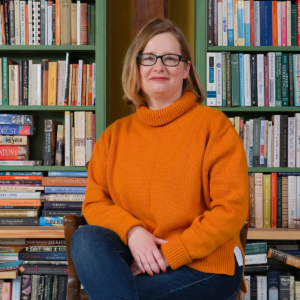
Jamison: I'm J.R. Jamison. Today on the Facing Project, I'll sit down with The Guardian’s TV critic and The i Paper columnist Lucy Mangan, who has spent a lifetime thinking about how reading shapes our lives. Her latest book, Bookish, is part memoir, part cultural analysis and part love letter to the written word. And if you've ever fallen in love with a book, like really fallen into it, you know the feeling: the sense that the world expands and somehow you are both more yourself and someone entirely new.
00;00;31;18 - 00;00;55;17
J.R. Jamison
And for many of us, reading just began as something small, like a bedtime story, or finding that first book that really stayed with us throughout the years, even if it was required reading. But the magic of stories set us on a course to discover more, like a framework for understanding life and the people around us, or being a balm when our souls need solace.
00;00;55;19 - 00;01;10;16
J.R. Jamison
Lucy and I will explore childhood reading, but also how books accompany us into adulthood, shaping how we think about and understand the world. Stay with us. [Theme music]
00;01;10;19 - 00;01;34;13
J.R. Jamison
Jamison: You're listening to The Facing Project, and I'm J.R. Jamison. My guest today is Lucy Mangan, the TV critic for The Guardian and a columnist for The i Paper. Her new book, Bookish: How Reading Shapes Our Lives, is a love story on how books not only shelter our souls through hard times and helps us find ourselves when we feel lost, but also helps us connect with the people we love through shared stories.
00;01;34;14 - 00;01;37;19
J.R. Jamison
Lucy, thank you so much for joining me on The Facing Project.
00;01;37;20 - 00;01;39;06
Lucy Mangan
Mangan: Thank you so much for having me.
00;01;39;12 - 00;02;01;11
J.R. Jamison
Jamison: I want to start at the beginning with you as a reader. Bookish, as you say, is a love letter to reading and how it comforts and challenges us throughout the years. Like all first loves, we remember the moment it happened. When you think about the first time a story really held you, what do you remember feeling in that moment?
00;02;01;12 - 00;02;26;25
Lucy Mangan
Mangan: I remember, I think maybe like most children, it was a picture book, and it was a Maurice Sendak picture book, but it wasn't Where the Wild Things Are. It was In the Night Kitchen, which is much weirder than the Where the Wild Things Are. It's very impressionistic. It's about Mickey falling through time and space, as I'm sure I don't need to explain to an American audience.
00;02;26;25 - 00;02;56;23
Lucy Mangan
I'm used to explaining it to an English audience, but it's much less well known here. And I remember, in that obviously nonverbal, inchoate way that very young children have, but I remember understanding at some level that if a book or pages and pictures and some words could do this weirdness, there was basically- there must be, logic dictated, there was nothing they couldn't do.
00;02;56;26 - 00;03;20;13
Lucy Mangan
And, you know, my life has basically been spent joyfully proving that theory correct. But in terms of, in terms of reading independently and finding and being enthralled to a story that I could just go away and read without my dad, who did the most of the reading to me, that was probably The Owl Who Was Afraid of the Dark.
00;03;20;16 - 00;03;22;04
Lucy Mangan
Is that famous over...?
00;03;22;07 - 00;03;24;27
J.R. Jamison
Jamison: I'm not familiar with that one.
00;03;24;29 - 00;03;32;28
Lucy Mangan
Mangan: It's the perfect- I can give you the conceit in half a line: It's a baby owl, Plop, who is scared of the dark. He's nocturnal.
00;03;33;00 - 00;03;34;01
Lucy Mangan
Which was...
00;03;34;04 - 00;03;34;05
J.R. Jamison
Jamison: Ahh!
00;03;34;07 - 00;04;02;09
Lucy Mangan
Mangan:...that word. And he's scared of the dark. Go! I mean, it's, it's perfect. So he learns gradually that the night is not scary because the moon was there and other owls are there, and fireworks can happen at night. And it's, it's a beautiful fable, really. And then after that, once you, once you've realized you can decipher these strange marks on these slices of tree by yourself, you're often right.
00;04;02;11 - 00;04;25;22
J.R. Jamison
Jamison: Yeah. I'm curious to know, so you're the TV critic for The Guardian, but Bookish is so much about your love of books throughout the years, starting, as we just talked about, your first love of a book when you were a child, all the way through your formative years, all the way up to adulthood, and how books have been a balm really for you throughout life.
00;04;25;22 - 00;04;39;03
J.R. Jamison
But I'm curious to know, as a TV critic, what is it about books that stay with us in different ways than a TV show or a film? I mean, they're both forms of storytelling, right? But are they different? Talk more about that.
00;04;39;04 - 00;05;00;23
Lucy Mangan
Mangan: They are both forms storytelling, but they are different, in that, I think in essence, reading is active and watching television or film is passive. So much more is done for you and it's fixed and it's presented to you and it's wonderful. I mean, I love television, I love film. I'm a monomaniac really about- because books are my main thing.
00;05;00;27 - 00;05;29;24
Lucy Mangan
But obviously as a TV critic, I watch a lot of television. I've always watched a lot of television as a child, and the best of television can do extraordinary things. And especially nowadays when we're in the, you know, we're in a golden age, really. Were so spoiled with everything from, you know, Madmen to anything. David Simon puts his pen to all the rest of it, but with books, everything's more elusive.
00;05;29;24 - 00;05;49;19
Lucy Mangan
It's more evocative. You are- you bring your imagination to it far more. You have to, you know, they are just marks on a, on a page. You bring your own, you know- everyone's got a slightly different version of Mr. Darcy. Everyone picks out a slightly different element of anything from The Da Vinci Code to Wuthering Heights. And that,
00;05;49;21 - 00;06;08;05
Lucy Mangan
and if you, if you're working like that, if you are bringing something, if you are engaged at that level, you remember more, and you think about it more, and it goes deeper. That's, that's just how we're built. And I think, I think that's, that's really the sort of differential magic of, of reading.
00;06;08;08 - 00;06;27;27
J.R. Jamison
Jamison: What do you think about book adaptations to film? [Laughter] I'm curious to know, you know, sometimes I watch a film and I, and I had read the book, and I think, oh, this really missed the mark, and I hope people read the book to know, kind of, the true story here, but I don't know if they ever will.
00;06;28;00 - 00;06;30;19
J.R. Jamison
What do you say about that as a TV critic?
00;06;30;24 - 00;06;31;12
Lucy Mangan
Mangan: It can be frustrating.
00;06;31;13 - 00;06;56;04
Lucy Mangan
If you're a, if you're a reader first and a watcher second. It can be frustrating because yes, I would say, broad brush terms, an adaptation will be less than or lesser than the book it comes from. Although, you know, recently we had Vladimir, the screen adaptation of her own book. I can't remember the writer, had three part name, it'll come to me. Which was just brilliant.
00;06;56;04 - 00;07;18;04
Lucy Mangan
And obviously you lose as little as possible, maybe, in the translation by a writer whose clearly as talented at screenwriting as she is at novelizing, which is not always the case, there's completely different- such different skills. But yes, mostly, if it's a good book, especially if it's a classic, especially you, you have to lose something. Because you're not,
00;07;18;05 - 00;07;39;08
Lucy Mangan
you're not capable of diving into that kind of- doing that kind of interiority. The media doesn’t lend itself to that, it's fine. But yes, if you, you do want to say- if someone, you know, loved Emerald Fennell’s Wuthering Heights, you want to say, “Great. You might not love the book.” And vice versa, if you loved Weathering Heights, you might not love her version.
00;07;39;09 - 00;07;50;01
Lucy Mangan
If you could hold the two versions in your head and like them differently, and that's fine. But go from one to the other expecting the same, you'll be, I don't know, thrilled or disappointed, depending [laughs]
00;07;50;04 - 00;07;50;17
J.R. Jamison
Jamison: [Laughing] Yeah.
00;07;50;21 - 00;07;51;27
Lucy Mangan
Mangan: ...where you start from.
00;07;52;01 - 00;08;11;07
J.R. Jamison
Jamison: Well, I want to talk about entertainment and entertaining. You talk in Bookish about reading as something that didn't just entertain you but accompanied you. I'm wondering, in those early years, as you were falling in love with books, what did books seem to understand about you that maybe people didn't?
00;08;11;12 - 00;08;36;05
Lucy Mangan
Mangan: I think books, books really understood that I was bookish. They understood that I was quite quiet, that I wasn't very good at talking to anyone and everyone as, as so many people seem to be. And, and that I liked being alone, and that I liked coming to people on my own terms, which, of course, you can't do with people.
00;08;36;05 - 00;08;55;03
Lucy Mangan
That's that's the difficult thing about people, especially when you're a child and you're not choosing your companions to a massive degree, but with books, you know, they'll wait for you. You can go to them in the right and pick out the one that's right for your mood, which is, you know, you can do it with people, but they tend to object if you do it too often.
00;08;55;04 - 00;09;15;03
Lucy Mangan
And yeah, they made me realize I was happier or, or very happy and maybe happier than other people tended to be, to be on my own and reading about things that are sort of comfortable speed and, and slight remove from the very muchness of life.
00;09;15;06 - 00;09;40;29
J.R. Jamison
Jamison: Well, there's this fascinating tension in the book between solitude and connection. And, as we just talked about, right, reading can often be solitary even though we're with characters and we're, you know, taken away into these wonderful- taking on these wonderful journeys. But even though it's solitary, right, it can be deeply communal in its impact. How do you think about that balance?
00;09;41;01 - 00;10;06;15
Lucy Mangan
Mangan: It's such a strange thing, isn't it? Because it is, it is a solitary activity, and that's often why people get almost annoyed when they see a child reading or a person reading, you know, especially in a public place, because they can tell, you know, there's something that sort of is exclusionary about it. And often people just kind of, just, you know, spines got- the hackles go up and they don't like it.
00;10;06;16 - 00;10;24;20
Lucy Mangan
But of course, a step beyond that, what you're doing is engaging not only with the writer's mind, but you're engaging with all the minds, in some way, in a sort of ineffable, inexplicable way. But you're engaging with all the minds that have ever read that book, and then you can go away and read other books; books by those minds that have read that book.
00;10;24;21 - 00;10;42;02
Lucy Mangan
And of course, you can talk to people who have read that book, and you find that kind of common ground with people like, like other people might get talking about their clothes or, “I, did you buy that from Wolf and Badger or something?” “Oh, yes, I did.” And instead, “oh, I've been reading that, and I don't know.” And you find you have that commonality.
00;10;42;03 - 00;10;58;27
Lucy Mangan
And of course, reading and books are part of culture. Culture is, by its nature, communal and social. These are our common bonds, our references. So even if you haven't read the book, you might, if someone says, “Oh, he's a bit Heath Cliff,” rather than, you know.
00;10;58;28 - 00;11;09;10
Lucy Mangan
Or, “She's a total-” or “He's a, he's, he's like Paddington Bear,” you know. You know these things, you know these things. And that's, that's the communal bit.
00;11;09;11 - 00;11;29;10
J.R. Jamison
Jamison: And I think too, we all read books differently depending on where we are in our life in the moment. And I think that communal aspect of it, too, helps us see different perspectives on how others might navigate the world. What do you think about that?
00;11;29;11 - 00;11;50;21
Lucy Mangan
Mangan: Yeah, I mean [sighs] it's, that's, I mean, that's the fascinating thing, isn't it? When you see someone reading a book, and maybe a book you've read or maybe you haven't read, either way, you can look at them and go, I wonder what they're getting out of it. I wonder why they chose it. I wonder why they came to it. Are they reading it just for general solace?
00;11;50;22 - 00;12;18;20
Lucy Mangan
Or pure entertainment? Does it- If they're reading a misery memoir, are they reading it in that kind of voyeuristic way because they lead very happy, contented, protected lives? Or are they reading it at completely the other end of the of the spectrum, just to know that they're not alone. Or, you know, and they could be anywhere in between. You- and multiply that by a million for every book, and a million million for every other book.
00;12;18;21 - 00;12;30;01
Lucy Mangan
And that's, that's reading, that's literature, that's, that's humanity. And, you know, we all contain multitude. Each book contains multitudes. And you can't do the maths [on it].
00;12;30;04 - 00;12;57;13
J.R. Jamison
Jamison: I'm thinking too about how reading connects us to the feeling of not being alone, even though it is, as we've talked about, can be a solitary venture in some ways. But you write about solitude as in a way that's honest and not romanticized. I'm curious to know, how did reading shape your relationship with being alone and facing some of life's hardest challenges?
00;12;57;15 - 00;13;30;12
Lucy Mangan
Mangan: It gave, [sighs] I always, I've always had a good relationship with solitude whether books are there or not. I find- and again, I didn't realize this until I'd, you know, read enough books with enough different characters in there, and also, I had my dad as the sort of single real life example of, of an introvert: someone who's depleted by general interaction with strangers rather than fulfilled by, which extroverts are.
00;13;30;12 - 00;13;41;08
Lucy Mangan
That's the clinical definition, which I find endlessly, endlessly fascinating. It's not about being shy, it's not about being noisy. It's about what you get from being around other people.
00;13;41;16 - 00;13;43;29
J.R. Jamison
Jamison: And how you recharge. [Laughing]
00;13;44;02 - 00;13;46;04
Lucy Mangan
Mangan: How you recharge, exactly.
00;13;46;06 - 00;14;28;21
Lucy Mangan
And books are how I recharge, I think, and that's an odd thing for child to be doing. People, again, don't like that. And it's very odd thing for a female child to be doing. And because you’re meant to be going out and making friends and being nice all the time, outward looking, outward looking, making connections. And then it's a, it’s- remains odd when you're a grown woman and, you know, meant to be taking on more and more responsibilities instead of hiding in the, in the back room reading your latest Freida McFadden or whatever you're enjoying currently.
00;14;28;23 - 00;14;56;21
Lucy Mangan
So it's, I don't, it gives, it gives validation to, to that kind of way of being. And it can give you an excuse as well. Oh, I've got, I've got to read this for work, or I've some- my friend really wants me to read this, or anything, anything. Just get away. And then also they, they, they are great company. You are in the company of, of people in the company of a good book.
00;14;56;24 - 00;15;06;18
Lucy Mangan
So I never quite, certainly when I was little, I never really understood why people were saying I should get out more. I'm like, I'm living a thousand lives in the space of, you know, my one little one.
00;15;06;20 - 00;15;07;08
J.R. Jamison
Jamison: Yeah.
00;15;07;11 - 00;15;16;25
Lucy Mangan
Mangan: Leave me alone. [dreamy acoustic music]
00;15;16;28 - 00;15;32;28
J.R. Jamison
Jamison: Well, there is something deeply personal about the way we attach to those people or characters, right, in books. When you think about the ones who have stayed with you throughout the years, what did they give you or ask of you?
00;15;33;01 - 00;16;06;20
Lucy Mangan
Mangan: I think every character gives you, really, a, a window into another soul. And often, especially in class- in the classics, gives you a window into a, also, a type of soul, you know, the, the predatory man or the charming hero or, you know, those kind of, not- I don't want to call them stereotypes because, because the best books, of course, go beyond that.
00;16;06;20 - 00;16;39;25
Lucy Mangan
And they're complicated, real rounded people. But I remember, you know, the first, the first, really, of two first really vivid characters I remember was one I don't think you'll be familiar with in the States, but Millie-Molly-Mandy, who was for young readers, what, about 6 or 7 year old readers? They were written in the 20s and 30s about this little girl who lived in a, even then, quite a quaint English village with thatched roofs and things, and I wanted to be her so badly.
00;16;40;00 - 00;17;02;18
Lucy Mangan
I was nostalgic for a time I didn't know and had never known existed and didn't know what the word meant, but I was immediately, I will yearn for this my whole life, and it's already long past. Oh well. And then a few years after that, I was reading Ramona, you know, the- all the Quimby books by Beverly Cleary.
00;17;02;18 - 00;17;27;24
Lucy Mangan
And she leapt off the page, and she was, she was everything. She was so funny. She was so astute. She was so interested and interesting and bright and vivacious and so, so beautifully realized. And she was, and she was everything different from me. And I was like, oh, but I love her anyway. I love her because of that.
00;17;27;24 - 00;17;50;19
Lucy Mangan
That's interesting. And so, so whatever you're reading, they can be, they can teach you so much, and they and, you know, you can define yourself by them or against them or you can, you know, with a general sense of tragedy that you really you are essentially Beezus and will be forever Beezus, and that the plaudits go to the Ramona's of this world.
00;17;50;19 - 00;17;59;21
Lucy Mangan
But you are what you are. But that's, that's great. And it's a, you know, it's very fortifying.
00;17;59;23 - 00;18;15;11
J.R. Jamison
Jamison: Well, you're quite funny. So, you know, if people read bookish, you actually have a really great sense of, of humor in your writing. So did Ramona essentially, maybe, influence the way you approach the word on the page?
00;18;15;17 - 00;18;38;13
Lucy Mangan
Mangan: Maybe she did. I mean, certainly her, her- the sense of freedom you get when you read the Ramona books and the independence is, was something so attractive to me. Because I, I was quite strictly brought up, and it felt very- it really made me feel like America was the land of, of the, of the free and the independent.
00;18;38;13 - 00;19;01;20
Lucy Mangan
Again, before I knew these, these phrases or these ideas, she just- I could only put it- It was the same with the, with the March sisters. I thought, oh God, I could be, I could be Joe if I want to write. But, but equally, you know, Beth and Meg seemed as much more or much less hidebound than, than the, the English heroines in my English books.
00;19;01;23 - 00;19;22;04
Lucy Mangan
And, Amy, I've always had a problem with. But, well, you know, we can come back to that. And so yeah, once you get, you know, talking about the international differences, you've got, you've got another world opening up. You don't even have to travel, which I also hate. I don't have a passport, I don't like traveling, but I don't need to.
00;19;22;08 - 00;19;24;04
Lucy Mangan
I've got all my books.
00;19;24;07 - 00;19;28;10
J.R. Jamison
Jamison: Unless you want to come to the States and do a book tour. [Laughing]
00;19;28;12 - 00;19;38;00
Lucy Mangan
Mangan: I feel I know the States thanks to Ramona [and the March Sisters] and Brown. I mean, if I've read those three, I know, I know the States. I'm Bill Bryson, you know.
00;19;38;01 - 00;19;47;07
J.R. Jamison
Jamison: Yeah. So you've been able to really journey here without ever actually coming here, which is the great thing about books, right?
00;19;47;10 - 00;20;21;05
Lucy Mangan
Mangan: Well, this is it, isn’t it? I think the people who don't read and still live their lives are so brave. If I didn't have the dry runs I've had of, of, you know, reading about first loves or reading about going abroad and what you might find in the different countries and different cultural differences there might be, and, and surviving breakups, and certainly any of the emotional difficulties or opportunities, a more, more optimistic person might say. I don't know what I'd have done.
00;20;21;05 - 00;20;50;04
Lucy Mangan
I'd have been adrift. I think, I think that's probably the mark of a real bookworm. I think who, you know, really wants to read about it certainly before she experiences it, and possibly even instead of experiencing things live. I remember my first kiss at, you know, my first proper kiss. I- very handsome boy in university, and was down by the river at dusk, and actually made my knees go weak.
00;20;50;05 - 00;20;57;15
Lucy Mangan
And instead of enjoying the moment for what it was, I was able, in my mind, I was like, oh my God, it's true. [Laughter] [All that stuff that’d been happening.]
00;20;57;17 - 00;21;02;14
Lucy Mangan
And that was the first time I thought, maybe I read too much. Can you read too much? [Laughs]
00;21;02;16 - 00;21;03;12
J.R. Jamison
Jamison: No.
00;21;03;14 - 00;21;10;03
Lucy Mangan
Mangan: Or is it good? Is it- Overall, I think it's better to know and be warned beforehand.
00;21;10;08 - 00;21;47;02
J.R. Jamison
Jamison: Yeah. That makes me think, you, you talk in the book about your mom and sister being non-readers or not bookish, and it made me think about my own family. I did not grow up in a bookish family either. And you talk about how people who don't read sometimes seem to have more, like, happiness or joy because they're unaware in some ways about so many different stories that are out there about the world, in some ways,
00;21;47;02 - 00;21;59;24
J.R. Jamison
right? So what would you say, what do you say to people who are non-readers about reading to try to bring them into, into story?
00;21;59;27 - 00;22;28;17
Lucy Mangan
Mangan: Well, it's interesting, you see, because I don't- it's a chicken and egg situation, you know. Are these people happier if they are happier- But if you know, are these people who seem happier and aren't readers happy because of that, or are they happier because they are just not over-thinkers and, you know, happier getting out and doing and being practical and actually living life and doing things, creating things, inventing things.
00;22;28;19 - 00;22;47;13
Lucy Mangan
You know, doing, doing a solid job for a living instead of noodling around with words and trying to get thoughts onto a page. [Light laughter] What kind of life is that? I mean, because my, you know, to take my sister and my mother as the examples, they are practical people. They could no more sit down and do anything- Can't sit,
00;22;47;14 - 00;23;24;25
Lucy Mangan
they can't sit and watch television even, let alone read a book. Now I can no more change them than I can change this sofa into a kingfisher. And you wouldn't want to change people like that. What, what, what I think is important when it comes to books and reading, and- is to give everyone, and especially obviously, children, the chance to experience stories that way, and all kinds of stories and all levels of stories and all complexities of stories, and let them choose whether it's for them.
00;23;24;29 - 00;23;53;29
Lucy Mangan
You know, the harm comes when a bookworm or potential bookworm is never given the opportunity to become his or her real self, who does or doesn't have the- is never given the social capital, because we forget how much energy and how much calm it actually takes to be able to develop reading skills and to be able to- for it to be able to become so easy that it becomes an abiding pleasure.
00;23;54;01 - 00;24;23;09
Lucy Mangan
And that's what schools need to focus on, and, you know, and ideally in the home, parents will be doing for a child. But I don't like it when we romanticize or overprivilege reading above everything else, books above everything else. And if you don't, if you're not a reader, you are in some way stupid, thick. See that- It's the only way to measure intelligence.
00;24;23;09 - 00;24;45;13
Lucy Mangan
Of course, it's not. What we want and what I want, and you know, a good teacher will want is simply for everyone to have the opportunity. Like no- good for- and for the non-bookworms and for the, you know, people who are really clever with their hands or can see things in three [dimensions] who are good at physics to, you know, learn about physics and learn about woodwork and metalwork and things like that.
00;24;45;15 - 00;25;06;22
Lucy Mangan
Everyone, you know, draw out these talents. And we can, you know, I've done it myself many times. You know, you lapse into the shorthand of, oh, reading is everything. Reading is wonderful. Reading is the only thing. It's the only thing. And romanticizing it in that way and alienating a lot of people who might just like to read a bit more or read a bit at all, and when they have, given the opportunity.
00;25;06;23 - 00;25;11;21
Lucy Mangan
So that's a very long way of answering a question, if indeed I did even.
00;25;11;27 - 00;25;33;13
J.R. Jamison
Jamison: I think that you absolutely did. And it does make me think about people who are bookish like me and like you. I don't find myself doing this particularly, and maybe you don't as well, but I have other friends who are bookish who love to post how many books they read in one month, and what those titles were, and that's their entire social media.
00;25;33;13 - 00;25;57;16
J.R. Jamison
And that can't be kind of alienating for people who maybe can only get through one title a month, or maybe not even half a book a month. I think to your point, if people find themselves on the page, it doesn't have to be the end all, be all. But, but there is a way to find exploration through writing that can complement other areas of your life.
00;25;57;16 - 00;26;05;02
J.R. Jamison
Whether you're an engineer or you're good with your hands, or you'd rather be out in the garden doing work, right?
00;26;05;04 - 00;26;35;09
Lucy Mangan
Mangan: Well gardening is an under-recognized creative outlet and force, but yeah, I find, especially as I come towards my menopausal years. But yeah, I mean, I briefly worked on, with some young people, on a magazine that was in a deprived area of London, and they all had to submit some writing, just, you know, a paragraph. And this boy, I say “boy,” I think he is a
00;26;35;09 - 00;27;06;14
Lucy Mangan
boy, 14, 15 is a boy, put down this paragraph and about a jostle: a jostling, bullying, incident in a, in a corridor. And it had no punctuation. He didn't have a clue about punctuation. Spelling was- I could make out what he was saying, but wasn't great. And no capital letters, no nothing. Very badly educated. And it was so full of color and life, and it was so vivid that I couldn't take my eyes off it.
00;27;06;15 - 00;27;27;07
Lucy Mangan
So we just went through it, and I said, “All I'm going to teach you to do is make it accessible to people who know the rules. And I'm going to show you where to breathe, where, where to tell them how to breathe and put the pauses in.” And we went through it, and I said, “But never, never doubt that you can, you can write.”
00;27;27;10 - 00;27;38;03
Lucy Mangan
And I feel like that way about the flip side of reading. It's- we conflate so many skills and so many abilities,
00;27;38;06 - 00;28;08;07
Lucy Mangan
when actually they can be so separate and so- and really interestingly so. Yeah, just, we just want a world where everyone can be as bookish as they truly are. Bookish people at my, at my school and in my era, I think, were, you know, very much marked. It wasn't a thing you did, whether you were male, female, boy, girl, whatever age you were, reading was really uncool and embarrassing, and you deserved to be bullied for it.
00;28;08;09 - 00;28;13;28
Lucy Mangan
I think better now, certainly in this country as
00;28;14;01 - 00;28;50;00
Lucy Mangan
it’s sort of become more democratized. One of the few possibly good things about the internet is that access to authors and that kind of thing, and the process has become demystified and makes it look almost that crucial bit more doable, more ordinary, more possible. I think that's really helped. And of course, J.K. Rowling transformed the children's publishing world into something quite stellar and gave a sort of hint of celebrity to, to it, which does help bring in the kids.
00;28;50;02 - 00;29;10;15
Lucy Mangan
And so I loved, I love to see how much more willing children are these days to talk about the books they're reading and discuss it, and not, even if they're not into it, not automatically. It's lovely. I think that's a real- it's one of the few measures of progress I cling on to as I look down the generations.
00;29;10;17 - 00;29;38;04
J.R. Jamison
Jamison: Yeah. I think that access to authors with online visibility and people talking online about books makes reading cool, right? Like, it makes it, it makes it seem in vogue, which it should be in vogue. I do want to talk a bit about reading as a form of protection. Talk more about that. How can reading act as a form of protection for those who maybe feel like they are alienated?
00;29;38;11 - 00;30;06;09
Lucy Mangan
Mangan: The thing about reading and books is that they can- [sighs] It enables you to, to see beyond your own life and your own perspective and also the perspectives you're being fed and the views you're being given. And you know, because especially when you're young, you tend to live in a fairly - I always get this word wrong - homogenous environment, you know, a undifferentiated perspective.
00;30;06;09 - 00;30;35;04
Lucy Mangan
You know, your family probably all believe roughly the same thing, your friends; you live in a neighborhood where you're unlikely to be greeted with a plethora of equally, you know, visibly held views. And so, but you can go into any book in your own time and see different stuff; stuff that will resonate with you; stuff that will speak to things perhaps you're only discovering now about yourself.
00;30;35;10 - 00;31;21;05
Lucy Mangan
And I mean, what greater gift and comfort and relief is there than that? And I'm very lucky, you know, I haven't had to fight against much in my life. I, you know, so lucky, it's, it's disgusting. But when you do get those little bits of, of really acute insight into your own state, and certainly, you know, you have endless stories from, from gay friends who the first time they, they, they came across a queer character or something that, I mean, I was going to say I can't imagine it;
00;31;21;05 - 00;31;45;26
Lucy Mangan
I can only imagine it. But what, what a moment that must be to just have that, that burden of thinking you're alone lifted. And it can be for, for, you know, more, even more traumatic stuff if you, if something terrible is going on at home or it can be for, for, you know, much lesser stuff, smaller moments that we all need to know,
00;31;45;27 - 00;32;01;16
Lucy Mangan
“Oh, that's just a human thing. Oh, everyone does- okay.” I remember, you know, first time I came across a character who sort of thought in three layers down, she thought the easy thought first, and then she thought, Oh well, in that case, that, and then the underneath bit of her, the bit she didn't like very much said. But I was like, “Oh, oh, good.
00;32;01;16 - 00;32;15;07
Lucy Mangan
We're all horrible.” [Laughter] So it doesn't always have to be huge, horrible things. It's enough to know you are, you are in some way connected to every other human being on the planet, because our brains are all basically the same.
00;32;15;08 - 00;32;38;26
J.R. Jamison
Jamison: Yeah, I mean, it's the saying that stories are mirrors and windows, right? They reflect back to us and they also open us to other places and people, which makes me think about empathy, which is so much of the work we do here at the Facing Project. And we like to say, right, that books and stories help us understand others.
00;32;38;28 - 00;32;49;27
J.R. Jamison
I'm curious to know, have you ever been surprised by something you read and how it helped you discover something about yourself? What did that look like?
00;32;50;00 - 00;33;19;04
Lucy Mangan
Mangan: In terms of, I think, I think you can't beat- Hmm, is this me privileging reading over everything? No, I don't think so. I think you can't beat reading for cultivating empathy simply because it's reading, or it's books, that give you the detail you need to follow someone's thoughts through and feelings through to, you know, where they start from and where they get to, and why they do this and why they do that.
00;33;19;06 - 00;33;43;15
Lucy Mangan
And, whereas with with television and film however nuanced and sophisticated it can be, you're going too fast, you can't go back and just, just reread that sentence just quickly and then keep, keep building on it and keep accreting knowledge like that. A film or television program is over very quickly. And yes, you can now, thanks to streaming or else, you can go back and back.
00;33;43;17 - 00;34;35;03
Lucy Mangan
It's not quite the same as doing it as organically as you, as you read. And I think, you know, we've touched on the internet already, but I think that's possibly what we're losing with, with the internet and social media, is that ability A. to pay attention for that long, simply that long; B. to pay attention that closely and be willing to follow a really, you know, incremental, delicate emotional journey that we're really getting to understand why this character did that because of the stuff behind him. [Intricate cello music crescendos]
00;34;35;05 - 00;34;52;18
J.R. Jamison
Jamison: Well, touching on rereading, so, revisiting stories and returning to the pages of the same book at different stages of life, right, because stories bring us different things and different moments of our lives. What has that process revealed for you?
00;34;52;20 - 00;35;11;01
Lucy Mangan
Mangan: Oh, it's terrible. So you have to extend yourself some grace, I think, when you reread a book, because you, you can easily, or I can easily, certainly, slip into the, “Oh, how could you not see? How could you be so young and foolish and ignorant and that?” Well, because you were young and foolish and ignorant. And that's okay. Did you want to be born 40?
00;35;11;03 - 00;35;40;27
Lucy Mangan
Well, yes, I did want to be born 40, but you can't be born 40, and so all you can do is sort of laugh at yourself and, and go, “Oh, haven't I learned a lot?” Or, you know, come to understand a bit more. Partly thanks to 1984 and George Orwell. About 1984 and George Orwell now, when I reread him as, you know, a documentary.
00;35;40;29 - 00;36;04;09
Lucy Mangan
But any, any book that you go back to, I mean, I remember reading, [laughs] remember reading The Da Vinci Code for a second time just a couple of years after it had come out. I can't remember why I was reading it for a second time. I really do think it was to do with work. It’s not an excuse, but I can't imagine I- because I never pick up a thriller a second time.
00;36;04;11 - 00;36;36;13
Lucy Mangan
But I remember thinking, how did I read this and not see how badly written it was? And it's because I picked it up as a thriller with no expectations other than a good, pacey read with lots of twists and turns and riddles and answers, which of course he delivers in spades. But it was only afterwards, you know, when I came to having a bit, a bit older, a little bit wiser, but also certainly a bit more of, been doing a bit of, a bit more writing in between.
00;36;36;13 - 00;37;04;20
Lucy Mangan
So I think that also ruins you for reading for a while, because you come back and you see even in, you know, really well written books, you look at, you look at the form and style and what's going on more than you, than you come to it as a new rereader. But yeah, that was a bit of a facer that I almost preferred rereading 1984, which was- just gets more and more terrifying obviously [laughter] every passing moment.
00;37;04;21 - 00;37;27;00
J.R. Jamison
Jamison: Yeah. When you return to a book, are you reconnecting with the text or are you reconnecting with your former self? So what I mean by this is, how much do we remember about books, about the books themselves, or how much of it is really about who we were at that moment when we read them?
00;37;27;00 - 00;37;49;08
Lucy Mangan
Mangan: I think it's both because I think it's such a porous boundary, because, especially if you really are a keen reader, the books do shape you as they going along. There's a, there's a, a psychologist once described reading a book: it can be, it can be like providing the key and- the lock and the key at the same time.
00;37;49;09 - 00;38;19;09
Lucy Mangan
So you sort of read about something that's a new concept or a new emotion or a new idea, and it gives you the key to understanding it at the same time. And so if that's the dynamic, then it's almost impossible to separate the book from the reader you were and were becoming in the process. And so when I reread a book, which I don't do enough because I'm so keen, I've been so keen for the last couple of decades just to read as much fantastic new stuff as I can.
00;38;19;11 - 00;38;37;06
Lucy Mangan
And I'm sort of hoping that I'm building up favorite rereads to come in the, in the future. But I remember, I remember both, I remember where I was, I remember what I was doing, I remember how I felt, I remember, yeah, what stage, what sort of gestational stage you were at when you read it for the first or the second time.
00;38;37;08 - 00;38;48;07
Lucy Mangan
And Caitlin Moran says something about just rereading The [Secret] Diary of Adrian Mole [Aged 13 3/4] again. Is that, did that make it over there, over to you?
00;38;48;07 - 00;38;50;27
J.R. Jamison
Jamison: I am not familiar with that one.
00;38;50;29 - 00;39;18;19
Lucy Mangan
Mangan: It’s a teenage, teenage diary of a very great bestseller in about 1984, over here by Sue Townsend. And Caitlin was saying that when she read it the first time at the age of about 13, obviously Adrian was her hero. And now when she, she reread it recently for, for work, she's a columnist, and she identified with his mother and wanted to slap him quite often.
00;39;18;21 - 00;39;40;28
Lucy Mangan
And she says, “No doubt in the years to come, I'll identify with Bert Digby,” who's the pensioner who lives down on the allotment. And it's that, isn't it? You know, these, these, these characters reemerge and go, oh, how did I not see how this woman is suffering? How do I not see why she's so tired? And but again, but again, some, at some level, you do know that.
00;39;40;28 - 00;39;54;07
Lucy Mangan
And that's what prepared you for some of adulthood. All these vestigial, pre-vestigial selves, almost shadow selves, then become realized by in real life. It's fascinating.
00;39;54;14 - 00;40;17;22
J.R. Jamison
Jamison: And it's interesting to find ourselves in other characters we might not have when we read the book previously as we age. Right? I find that in stories that I revisit as well, that I might relate more when I'm reading a young adult book with a parent than I might with the actual child. Even though I like to think I'm still the child at heart.
00;40;17;23 - 00;40;21;25
J.R. Jamison
Right? But now I kind of understand the parent a little more.
00;40;22;00 - 00;40;50;02
Lucy Mangan
Mangan: Yeah. The truth, the truth will out. So if you, if you read The Hunger Games as a parent, it's a completely different book or series of books. You know, you read it as a child, like, “Oh, the heroine, who is she going to choose? Peeta or the other guy?” And you read it as a parent or a, you know, sentient adult and go, “These children are being taken from their parents and being killed!”
00;40;50;02 - 00;41;12;15
Lucy Mangan
This would not happen! This would, this would destroy you! It would destroy a country. It would destroy anything. There would be riots immediately.” And the, the conceit, unfortunately, because I love that, I loved The Hunger Games the first time around, falls, falls apart. And you can't really reread it with any degree of, of immersion. But, God, they're fun while you can.
00;41;12;17 - 00;41;37;02
J.R. Jamison
Jamison: I want to talk about the digital age that we're living in, the access to so many stories in different ways has actually some worried that reading is going down. Reading actual physical books is going down. Are you concerned about that? Or do you think that consumption is simply evolving?
00;41;37;05 - 00;42;10;25
Lucy Mangan
Mangan: No, I think, I think we're losing something. It would be lovely to think we were just evolving, but I don't think that's the case. It is not the case that, that there is always progress. And I don't think that the the internet represents, you know, unmitigated progress. I think it's perfectly fair to say we are gaining some things, but we are losing important things in the process.
00;42;10;27 - 00;42;32;27
Lucy Mangan
We are becoming de-skilled because humans are designed to take the easiest route to anything. You know, that's, that's millions of years of evolution talking. And so if it becomes easier just to find your information on screen and bite sized bits or videos, you're going to do that. Children are going to do that without question because they don't know any better.
00;42;32;27 - 00;42;55;02
Lucy Mangan
And you can't explain to a child, “Actually, it's going to be much better in the long term if you learn to use Encyclopedia Britannica!” [Laughter] You know? Save your breath. And we're all, we're all guilty of, of scrolling and doom scrolling. And, you know, suddenly you look up in an hour or two hours has gone past when you could have been, you could have been getting on with Crime and Punishment, and you weren't.
00;42;55;04 - 00;43;20;25
Lucy Mangan
So we're all vulnerable to it. We're all- and so we're all losing that ability to pay attention, that ability to follow a long, convoluted Victorian sentence. I know I am when I go back now to, to turn to Pride and Prejudice, did I really, did I really once just read this like it was nothing?
00;43;20;27 - 00;43;50;23
Lucy Mangan
And so I think, yes, we are, we are losing something here. We are losing both the skills to read and the stuff that we've talked about already, the, the, the very delicate, detailed process it takes to build empathy and build, yeah, build the ability to understand other people. That's, that's you know, that's tricky stuff. And you can't- not everything is equal when it comes to helping you learn that.
00;43;50;25 - 00;44;14;14
J.R. Jamison
Jamison: I also think of reading as a form of meditation. So I'm a meditator, but I also when I find myself lost in a book, it's also like I don't want to say a spiritual experience, but when you get really entangled into a story, I can't wait to keep coming back to it, and it's my time to be in the book.
00;44;14;14 - 00;44;23;15
J.R. Jamison
So what do you think is at stake when we're living in a world that's speeding up when reading really asks us to slow down?
00;44;23;18 - 00;44;55;26
Lucy Mangan
Mangan: I think it's perfectly legitimate to call it a spiritual experience. What is it if it's- if, if touching another person's brain with your brain is not a spiritual experience, then I don't know what is. You know, between the other person's brain and God, you know, those are degrees of ineffability that almost, almost don't matter, certainly on a day to day, practical basis. You are doing something extraordinary when you, when you read and when you get, as you say, fully immersed in a book. That's, that's magical.
00;44;55;29 - 00;45;29;08
Lucy Mangan
And I wish that at least once for everyone in their lives. Just so you know, you know, choose whether to pursue that or not by all means, but at least know what you're- what we're all talking about, what we're all aiming for, what we want for you. And I don't have a religious faith. I was, I was born into a Catholic family, and my, my, my family is my wider family is certainly very Catholic, but books are, books are my solace.
00;45;29;08 - 00;46;03;05
Lucy Mangan
Books are certainly, certainly the closest thing I have to what they talk about. And, and I, I'm glad I've got that, that, at least that degree of commonality with them. But yeah, books that books are solace. Books are, are about, are about, you know, swapping consciousnesses, which is what I, at least in part, understand religion or meditation and that kind of thing to be about,
00;46;03;08 - 00;46;05;11
Lucy Mangan
I think.
00;46;05;14 - 00;46;37;08
J.R. Jamison
Jamison: I find too when I write, it's a different level than when I'm consuming another writer's book. I'm curious to know, as- it's like a different form of spirituality, if we’re like placing that term on it again, because you're really trying to convey a message to a reader without them feeling like you're conveying a message to the reader, and you're wanting them to start to see themselves in the story.
00;46;37;09 - 00;46;56;25
J.R. Jamison
Right? So there's a different kind of place you got to be in your head as you're writing versus reading sometimes, right? I'm curious to know, as you were writing Bookish, what did you come to understand about yourself through that process that either surprised you or maybe unsettled you?
00;46;56;28 - 00;47;26;28
Lucy Mangan
I think I came to realize that I've led very little life or have had a very little life. I've, I've experienced a lot more things through books than I have in real life, I think to a really disproportionate degree. And I've had my share of sorrows and, you know, problems like we all have. But,
00;47;27;00 - 00;47;53;16
Lucy Mangan
certainly I know a lot more in theory than I do in practice, let's put it that way. And I suppose I was quite unsettled by that. And then I was further unsettled by how fine I was with that. I was like, well, what was I supposed to do? Go against every- nobody goes against every fiber of their being to lead a completely different life from, from what their temperament is telling them to do.
00;47;53;16 - 00;48;18;19
Lucy Mangan
And so I didn't. I kept reading and not going out when I didn't want to. And, you know, leading my life on my own little quiet terms. And so I look back and I'm quite pleased about that overall. But I was quite shocked when I noticed the real, real disparity between theory and practice.
00;48;18;21 - 00;48;31;05
J.R. Jamison
Jamison: If someone listening begins to think about their own reading life after hearing our conversation, what kinds of questions do you hope they're asking themselves?
00;48;31;07 - 00;49;02;17
Lucy Mangan
Mangan: I would hope they're just asking, “Do I read what makes me happy?” Because I think first, first of all, you know, if you're not a, you know, a monomaniacal reader or a real bookworm, that's the most important thing, because that's the only way you're going to- it’s the only way anyone gets any deeper into a hobby is, do you start off in a way that you find enjoyable? And then it leads you on to bigger and better things and deeper levels, harder levels, which is not to say less enjoyable, but you need to build to that.
00;49;02;17 - 00;49;16;20
Lucy Mangan
So is it making you happy? Are you reading the right-? If you have the urge to read, but then you pick up a book and you go, oh no. But you plow on. Don't do that. Don't do that. Ask what you really want to be reading. What do you want to be reading about, and what form do you want it to be in?
00;49;16;20 - 00;49;42;15
Lucy Mangan
And do you want much simpler sentences? Do you want much more complicated sentences? Do you want some flowery, gorgeous, stylistic, style-to-the-fore kind of prose, or do you want functional stuff that, that tells a cracking story and doesn't let flourishes get in the way? Or, you know, and eventually you'll, you'll find one that gives you both at your level that just suits you of each.
00;49;42;16 - 00;49;51;12
Lucy Mangan
And that will be another revelation. But yes, just, just ask if it's making you happy and if not, what would make you happy? And if it's not reading at all, that's fine too.
00;49;51;14 - 00;50;03;04
J.R. Jamison
Jamison: Yeah, and I think there are stories out there for everyone. It's just finding the right entry point into reading and then finding that whole subgenre that you fall in love with.
00;50;03;07 - 00;50;24;07
Lucy Mangan
Mangan: And it's very often not the stuff you were exposed to at school, or it's not the stuff that your parents had on the shelf. You know, just go, go wander around the library, go wander around a bookshop. People, people understand this, again, going to a bookshop. There's actual time and peace in a bookshop. People understand that. It's not, you know, it's not like going to the supermarket.
00;50;24;07 - 00;50;35;13
Lucy Mangan
You don't just go in for some salami and some sliced white, you know, you going to feel your book, let it come to you.
00;50;35;15 - 00;50;40;10
J.R. Jamison
Jamison: Yeah, and there's a lot of freedom in what's on those shelves too.
00;50;40;12 - 00;50;43;27
Lucy Mangan
Mangan: Yeah. Untold freedom. Untold freedom.
00;50;43;29 - 00;50;52;08
J.R. Jamison
Jamison: Lucy Mangan, author of Bookish, How Reading Shapes Our Lives. Thank you so much for joining me on The Facing Project. I've really enjoyed our conversation.
00;50;52;10 - 00;50;55;00
Lucy Mangan
Mangan: So have I, thank you so much for having me.
00;50;55;03 - 00;51;11;15
J.R. Jamison
Jamison: Bookish, How Reading Shapes Our Lives, is out now everywhere books are borrowed and sold. Learn more about Lucy Mangan on Substack at LucyMangan1.Substack.com or just search The Bookwormery. [Theme music]
00;51;11;17 - 00;51;19;24
J.R. Jamison
Jamison: Thank you again to Lucy Mangan for joining me on today's show and to her publisher, Pegasus Books, for providing a complimentary copy of Bookish,
00;51;19;27 - 00;51;45;04
J.R. Jamison
How Reading Shapes Our Lives. To listen to past episodes of this program, visit IndianaPublicRadio.org/TheFacingProject, or find us on your favorite podcasting app, or on YouTube or on the NPR network. Or just ask your smart speaker to play The Facing Project on NPR. To continue the conversation about this episode, find us on Facebook and Instagram at Facing Project.
00;51;45;07 - 00;52;09;19
J.R. Jamison
The Facing Project is recorded at Indiana Public Radio at Ball State University in beautiful and wonderful and evergreen Muncie, Indiana, and is produced by the amazing producer and audio engineer extraordinaire Sean Ashcraft. The show is distributed nationally through PRX. I am your host, J.R. Jamison. And until next time, I wish you the courage to share your own story and the empathy to listen to others.